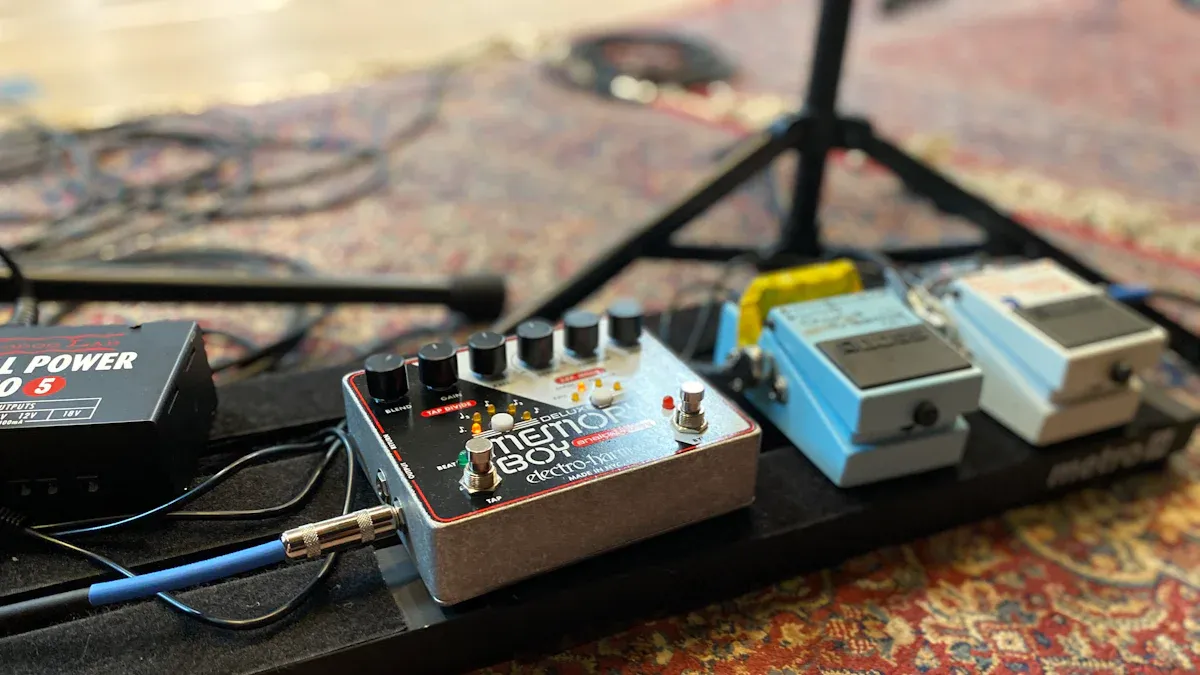
Effects pedals make instrument sounds different or better. They help musicians be more creative. A guitarist can use a pedal de efeito boost to make solos louder. They can add distortion for a stronger sound.
-
Common types include:
-
Distorção
-
Delay
-
Chorus
-
Flanger
-
Phaser
-
Reverb
-
Sintonizador
-
Looper
-
Principais conclusões
-
Effects pedals make instruments sound different. They help musicians be creative and stand out.
-
It is important to know the signal path. The way pedals are ordered changes the sound. This is like following steps in a recipe.
-
Musicians use many kinds of pedals, such as distortion and modulation. These pedals make new sounds and improve their music.
How Effects Pedals Work
Sound Alteration
Effects pedals change the sound of an instrument by using special electronic parts. These parts work together to create different effects. Here is how some of these parts help shape the sound:
-
Transistors and Diodes: These parts change the shape of the sound wave. They can make the sound rougher or add distortion.
-
Capacitors and Inductors: These parts control the timing and strength of the sound. They help create effects like echo or chorus.
-
Variable Resistors: These parts allow the player to sweep through different sounds. For example, a wah pedal uses this to make the guitar sound like it is talking.
Musicians use effects pedals to make their instruments sound unique. Each pedal can add a new layer to the music.
Signal Path
The way effects pedals connect in a setup is called the signal path. This path is important because it changes how the final sound comes out.
-
Each pedal in the chain has a special job. Some pedals make the sound louder, while others add effects like echo or distortion.
-
The order of pedals matters. For example, putting a chorus pedal after a distortion pedal makes the chorus effect stand out more.
-
Musicians think of the signal path like a recipe. Changing the order of pedals can make the music sound clear or muddy.
-
A good signal path helps each effect shine. It also keeps the sound clean and easy to hear.
Understanding how to use effects pedals and set up the signal path helps musicians get the best sound from their instruments.
Types of Effects Pedals
Distorção
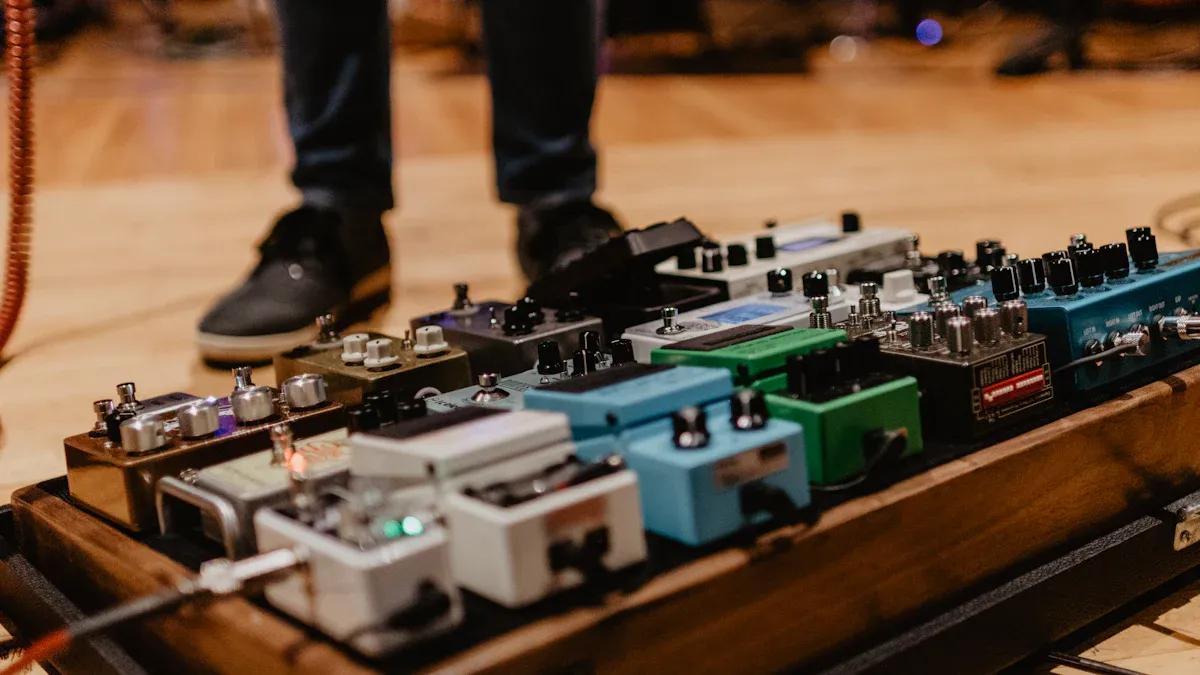
Distortion pedals make a guitar sound rough and strong. They do this by turning up the gain. This pushes the signal past what is normal. The sound wave gets clipped, which adds new harmonics. This makes the tone gritty and full. Players can use the distortion knob to make the sound sharper. This pedal is used in hard rock, punk rock, grunge, heavy metal, and some rap. Musicians use distortion pedals to make their guitars thick and bold. Their music stands out more with this effect.
How a distortion pedal changes sound:
-
The pedal turns up the gain and pushes the signal higher.
-
The sound wave clips and adds even and odd harmonics.
-
The tone knob changes all harmonics, and the distortion knob boosts even harmonics.
Modulação
Modulation pedals add movement and texture to music. They change the sound by shifting pitch, timing, or volume. Some common modulation effects are chorus, flanger, phaser, tremolo, vibrato, and auto-pan.
Chorus effects make the sound wider and richer.
Flanger effects give a swirling and dramatic feel.
Phaser effects create a soft whooshing sound.
Tremolo effects move the volume up and down in a pattern.
Vibrato effects change the pitch a little, making the sound lively.
Auto-pan effects move the sound from left to right for a cool stereo effect.
Many famous artists use modulation pedals. For example:
|
Artista |
Song |
Modulation Effect Used |
|---|---|---|
|
Andy Summers |
Message in a Bottle |
Chorus Pedal |
|
David Gilmour |
Shine On You Crazy Diamond |
Modulation Effects |
Time-Based
Time-based effects pedals like delay and reverb add space to music. Delay pedals repeat the sound after a short time. This makes echoes that add rhythm and depth. Reverb pedals make the sound feel like it is in a big room. This gives music a warm and full feeling.
|
Evidence |
Descrição |
|---|---|
|
Depth and Complexity |
Time-based effects add depth and make simple sounds richer. |
|
Immersive Textures |
These pedals create wide and deep textures in music. |
|
Sense of Space |
Reverb makes music feel bigger and more natural. |
Musicians can pick analog or digital time-based pedals. Analog pedals use old parts and sound warm but have fewer options. Digital pedals use chips and give more control and sounds.
-
Analog delay pedals make warm repeats that fade away.
-
Digital delay pedals give clear repeats and many effects.
Dynamic Effects Pedals
Dynamic effects pedals control how loud and strong the sound is. Compressor pedals help balance loud and soft notes. They make music smoother and more even. Compression makes quiet notes louder and loud notes softer. This helps every note be heard.
Boost pedals are another dynamic effect. They make the instrument louder but keep the same tone. Musontek’s The Shit Power is a great boost pedal. It gives up to 21dB of clean boost. This helps solos stand out in the mix. The pedal keeps the sound clear and natural. It works well for live shows and studio recording. It fits many music styles and helps musicians show their best.
Filter & Wah
Filter and wah pedals change the sound by moving certain frequencies. Wah pedals act like a bandpass filter. They sweep a center frequency when the player moves the pedal. This makes the classic “wah-wah” sound. Artists like Jimi Hendrix and Eric Clapton made it famous. Wah pedals became important in rock, R&B, and funk in the 1970s.
Filter pedals, like envelope filters, work differently. They change the cutoff frequency based on how hard the player hits the strings. This makes funky sounds that react to the player’s touch.
Popular types of effects pedals among musicians include:
-
Looper pedals
-
Wah wah pedals
-
Chromatic tuners
-
Volume pedals
-
EQ pedals
-
Overdrive pedals
Tip: Musicians pick effects pedals based on their music style and the sounds they want. Planning the pedalboard and choosing the right pedals helps them get the best sound.
Using Effects Pedals
Practical Uses
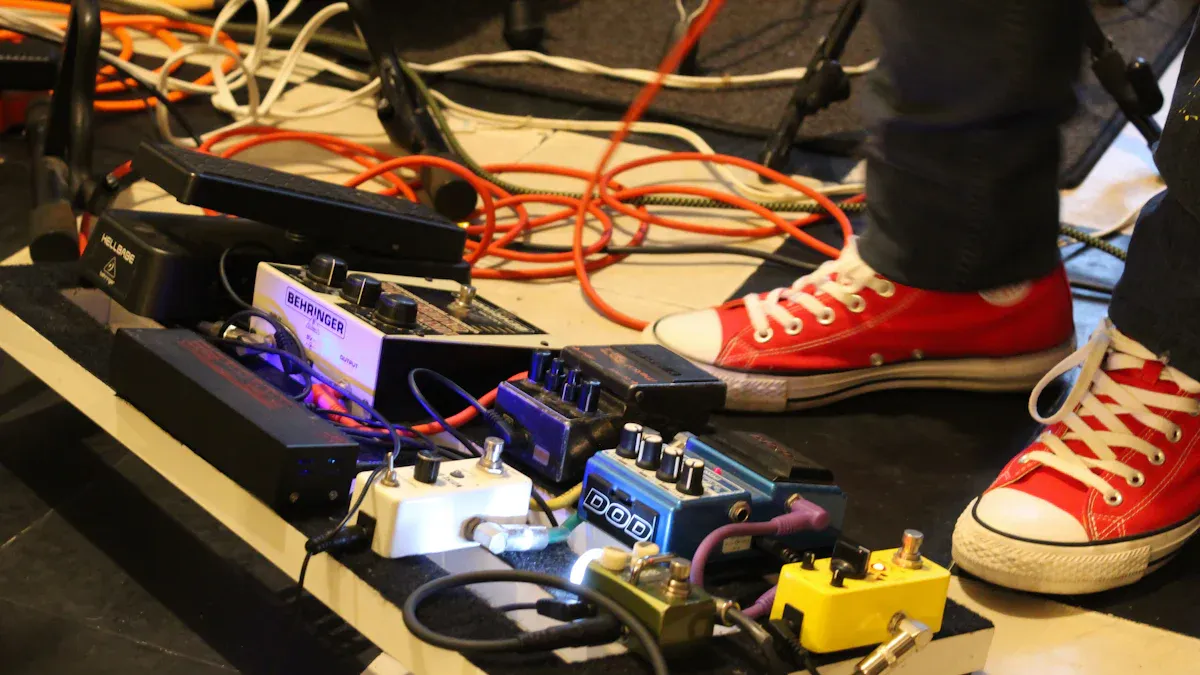
Musicians use effects pedals on stage and in studios. On stage, pedals let players change their sound quickly. This helps them match the crowd’s mood and each song’s needs. Many artists put their pedals in a certain order to get the sound they want. They also use reamp boxes to control sound levels and stop unwanted noise.
|
Creative Control |
Pedals let musicians change their sound during shows. This can help them be more creative and inspired. |
|---|---|
|
Signal Flow Considerations |
Musicians need to know how pedals connect. This is important for good live sound. |
|
Reamp Boxes |
Reamp boxes help control sound levels. They also stop problems like ground loops. These are helpful for live shows. |
In studios, musicians use many pedals to make new sounds. But using too many pedals can cause problems. Too many can make noise or weaken the sound. Pedals need care to work well. Cleaning and checking wires keeps everything working right.
|
Challenge |
Descrição |
|---|---|
|
Overloading the Signal Chain |
Using too many pedals can make noise and weaken the sound. |
|
Neglecting Proper Maintenance |
Pedals need to be cleaned and checked for loose wires. |
|
Ignoring the Importance of Context |
Effects work best when used in the right music. |
Tip: Musicians should wipe pedals with a soft cloth. They should not use strong cleaners. Cleaning often keeps pedals working well.
Creative Benefits
Effects pedals give musicians more ways to change their sound. Players can try new ideas and make their own style. Many famous guitarists have special sounds because of their pedals. Jimi Hendrix used the Dallas Arbiter Fuzz Face for his sound. David Gilmour used the Electro-Harmonix Big Muff Pi for his solos.
-
Effects pedals let musicians change their sound more than amps alone.
-
Pedals help musicians be creative and try new things.
-
Using different pedals makes a player’s sound unique.
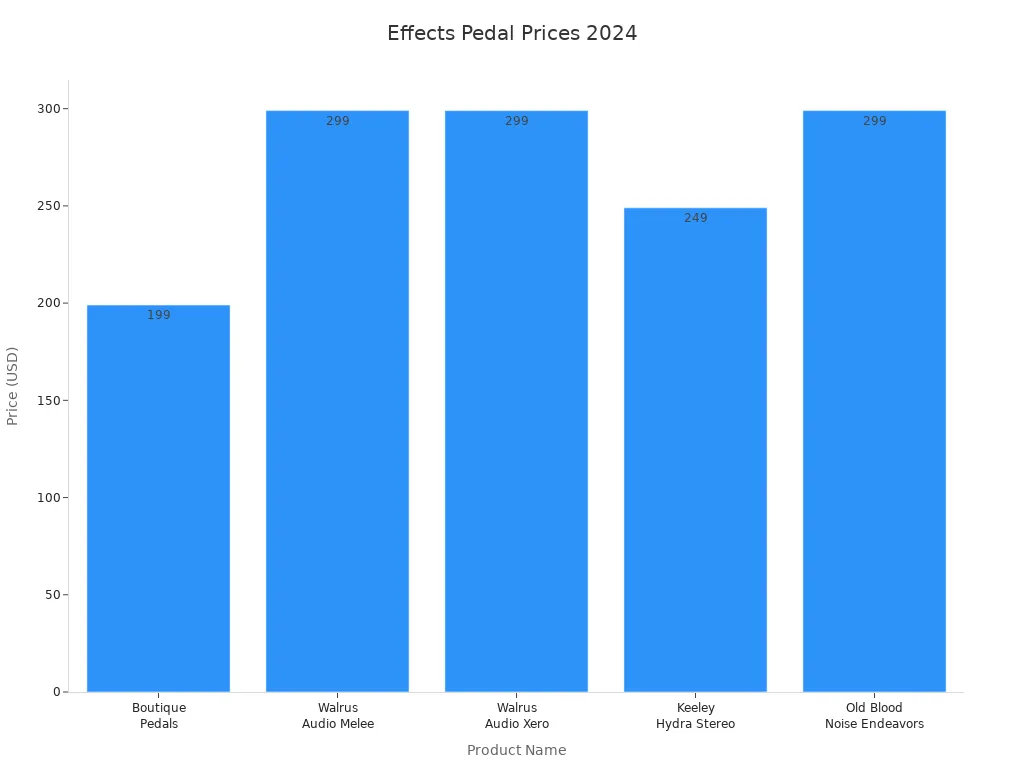
Musicians can buy pedals at many prices. Cheaper pedals are good for beginners. Boutique pedals cost more and have special features.
|
Product Name |
Preço |
|---|---|
|
Boutique Pedals |
$199.00 |
|
Walrus Audio Melee Wall of Noise Halloween Edition 2024 Reverb and Distortion Effects Pedal |
$299.00 |
|
Walrus Audio Xero Polylooper Dual-Channel Looper Pedal |
$299.00 |
|
Keeley Hydra Stereo Reverb Tremolo Effects Pedal |
$249.00 |
|
Old Blood Noise Endeavors Black Fountain Stereo Delay Effects Pedal |
$299.00 |
Wireless and wired pedal systems can sound different. The sound depends on the gear and the technology used. Analog wireless systems squeeze the sound before sending it. This can change how it sounds. Digital systems keep the sound the same, so it is more natural. Good gear is important for both types to sound great.
Effects pedals let musicians change their sound and style. Players can control their sound better and make new tones. Many artists try new pedals, which helps them be creative for many years:
|
Decade |
Influence on Musical Creativity |
|---|---|
|
1990s |
Bands like Nirvana and Sonic Youth used many pedals. This helped them make new sounds and start genres like shoegaze. |
|
2000s |
Multi-effects processors and boutique pedals became popular. Musicians started to experiment and change their sound more. |
|
Present |
There are more pedals than ever. Musicians have many choices and keep making new sounds. |
Musicians can use different effects, like a boost pedal such as The Shit Power, to find new sounds.
FAQ
What does a boost pedal do?
A boost pedal increases the volume of the instrument. It helps solos stand out. The original tone stays clear and strong.
Tip: Musicians use boost pedals like Musontek’s The Shit Power for clean, powerful sound.
Can effects pedals work with instruments other than guitars?
Effects pedals work with bass guitars, keyboards, and some electronic drums. They change and enhance the sound for many instruments.
How should a musician care for effects pedals?
Musicians should clean pedals with a soft cloth. They should check cables often. Proper care keeps pedals working well and sounding great.