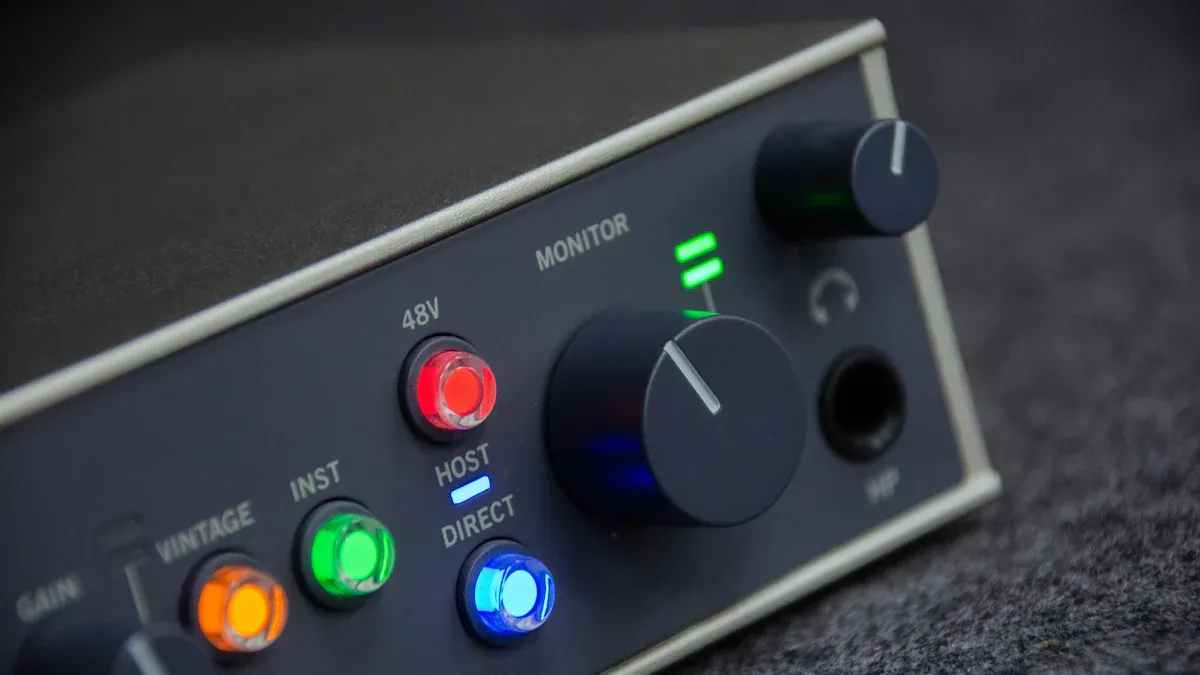
A passive stereo DI box acts like a translator for music gear. Sound engineers and musicians use these boxes to connect instruments to mixers. This helps keep the sound quality good. The Passive DI Box PD1L changes noisy, unbalanced signals into clear, balanced ones. Many people ask about the difference between a Passive DI Box and the famous Passive DI Box PD1X (History). The main thing is knowing what “passive” means. It needs no power and just lets the signal flow. “Stereo” means two channels of music can travel together.
主要收获
A passive stereo DI box lets you connect instruments to mixers. It does not need any power. This makes setting up fast and simple.
The Musontek PD1L is a good pick for musicians. It keeps the sound clean and cuts down on noise.
Passive DI boxes work best with strong signals. Keyboards and electric guitars are good examples. They keep the sound true to the original.
Using a passive DI box stops hum and buzzing. Ground lift and pad switches help make the sound better.
These boxes are great for live shows and studio work. They are strong, easy to carry, and simple to use.
Passive DI Box features

What makes it passive
A Passive DI Box is simple. It does not need batteries or power cords. It works quietly with its own parts inside. Musicians like it because it keeps their sound clean. The Musontek PD1L is easy to use. You just plug it in. You do not need to find a power outlet. The box keeps the real sound of every instrument.
Here’s a quick look at what makes a DI box passive:
Characteristic | 说明 |
|---|---|
简约 | Passive DI boxes are easy and dependable. They do not have active electronic parts. |
No power source needed | They do not need batteries or outside power, so they are handy for many uses. |
Tone preservation | They do not change the sound, so the instrument’s tone stays the same. |
Suitable for active pickups | They work well with instruments that have active pickups and strong signals. |
价格 | Passive DI boxes usually cost less than active ones. |
The Musontek PD1L has a transformer inside. This part stops unwanted noise and hum. It also has switches for ground lift, pad, and phase reverse. These switches help fix sound problems fast.
Stereo signal handling
Stereo sound makes music exciting. A Passive DI Box with stereo can handle two channels at once. This means a keyboard or drum kit can send left and right sounds separately. The Musontek PD1L handles stereo signals very well. It keeps both sides clear and even.
The box sends two mono signals for a good stereo sound.
It stops phase cancellation, which can hurt sound in mono setups.
If a sound engineer wants one signal, the box can join both channels. It does this carefully to avoid phase problems.
Musicians like stereo DI boxes for keyboards and electronic drums. The PD1L makes sure every note goes to the mixer the right way.
Build and components
The Musontek PD1L is strong and packed with features. It uses passive discrete parts, so anyone can plug in and play. You do not need to worry about power. The isolation transformer moves the signal and breaks ground connections. This stops hum and buzz from getting in.
Here’s a peek at the main parts inside:
组件 | 功能 |
|---|---|
Passive Discrete Circuitry | No power needed, just plug and play |
Isolation Transformer | Moves the signal and breaks ground connection |
GND Lift Shifter | Gets rid of ground loops |
Pad Shifter | Lowers signal levels |
Merge Mode | Handles line signal input |
Signal Phase Reverse Shifter | Flips the signal’s phase |
The ground lift switch helps stop annoying hum. The pad switch lowers strong signals, so they do not overload the mixer. The phase reverse switch fixes phase problems, especially with more than one microphone. The merge mode lets the box handle both instrument and line-level signals.
A Passive DI Box like the PD1L uses transformers to block ground voltages and remove ground loops. Active DI boxes use preamps to make weak signals stronger. They need power and are best for long cables. Passive DI boxes are simple and dependable, so many musicians like them.
Tip: The Musontek PD1L is tough. It works well on the road or in the studio. Musicians and sound engineers trust it for clear, noise-free sound.
How a passive stereo DI box works
Signal flow explained
Think about a musician using a keyboard with a Passive DI Box like the Musontek PD1L. The signal starts at the input. First, the instrument plugs into the unbalanced ¼” input. The signal goes into the transformer. The transformer changes the signal from high voltage to low voltage. The primary winding gets the signal and makes a magnetic field. This field moves to the secondary winding. It creates a new current there. The balanced signal leaves through the XLR output. It goes to the mixer’s microphone preamp. This all happens very quickly. The sound stays clean and strong. The PD1L is easy to use. Musicians can set up fast and focus on playing.
Role of transformers
Transformers in a Passive DI Box protect your sound. They keep the input and output apart. This blocks unwanted electrical problems. It stops ground loops and interference. These issues can cause buzzing or humming. Transformers also match the impedance between the instrument and the mixing desk. When the transformer increases the current, it lowers the voltage. The signal then needs a mic input to get strong again. This keeps the music clear. The audience hears every detail.
Noise reduction and isolation
Noise can get into any audio setup. The Musontek PD1L helps stop this. The ground lift switch breaks the link between the amplifier and the mixer. This stops ground loops. Ground loops often make hum or buzz. The pad switch helps when an instrument sends a strong signal. It lowers the volume a little. This prevents distortion. The sound stays clear. These features keep music sounding good on stage or in the studio. Musicians and sound engineers trust the PD1L for clean audio and easy performances.
Common uses for passive stereo DI boxes

Instruments and devices
Musicians love gadgets that make life easier. The passive stereo DI box steps up as a hero for many instruments. Keyboards often come with two outputs—left and right. The box takes both and sends them to the mixer, keeping the music wide and full. Electric guitars, especially those with active pickups, plug in and sound great. Electronic drum kits also join the party. They have lots of sounds and need both channels to shine. Even laptops and DJ controllers can use a passive stereo DI box to keep their beats clean and strong.
Tip: The Musontek PD1L handles all these devices with style. It keeps the sound clear, no matter what you plug in.
Live and studio applications
Bands on stage want their music to sound perfect. The Musontek PD1L travels well. It has a tough shell and does not need batteries. Sound engineers toss it in a bag and set up fast. In live shows, the box fights off noise and hum. It keeps the music crisp, even when the lights flash and the crowd cheers. In the studio, things get quiet. The PD1L still works hard, making sure every note gets to the recording desk without trouble.
Here’s a quick look at how passive stereo DI boxes perform in different places:
特点 | Live Sound Environment | Studio Settings |
|---|---|---|
System Noise Reduction | Reduces system noise effectively | May not be as critical |
设计 | Rugged design for high mobility | Focused on fidelity |
Power Requirement | No external power needed | Can use powered options |
Source Compatibility | Best for active sources | Works with both active and passive |
When to choose passive DI
Choosing the right box can feel tricky. If the instrument has a strong signal, like a keyboard or an electric guitar with active pickups, a passive stereo DI box fits the job. Live shows need gear that works fast and never quits. The Musontek PD1L shines here. It does not ask for batteries or power cords. In the studio, it keeps things simple and clean. For anyone who wants plug-and-play magic, this box stands ready.
Note: A passive DI box works best when the instrument already has power or a strong output. It keeps the sound honest and the setup easy.
Pros and cons of passive DI boxes
Advantages
A passive DI box is easy to use. Musicians and sound engineers like its simple design. You do not need batteries or power cords. Just plug it in and play music. This makes it less likely to break. It works well even if the band moves a lot or the gear gets bumped. The box keeps the sound clear and natural. Every note can be heard.
No active electronics means fewer things can go wrong.
The strong build helps it last through tours and shows.
Fewer cables and no power needed make setup quick.
Many people say the sound stays pure, with no extra noise.
Limitations
Even good gear has some problems. Some musicians find that a passive DI box does not work with every instrument.
Passive DI boxes sometimes have low input impedance. This may not work well for some guitar pickups. It can make electric guitars and acoustic pickups sound worse. But they work fine with active basses and keyboards.
Transformers in passive DI boxes cannot always reach high input impedance. This can be a problem for some uses.
Some engineers say problems happen when the pad switch is off. This can make the DI box, mic preamp, and PA system get overloaded.
Ideal situations
A passive DI box is great in many places. Musicians who want a natural sound often choose it. It works best with instruments that have strong signals, like keyboards or basses with active pickups.
No power supply is needed, so you can use it anywhere.
It handles strong signals easily.
Good for people who want their sound to stay pure.
Usually costs less than active DI boxes, so it is good for saving money.
A passive DI box is a smart choice for people who want simple, tough, and honest sound.
Passive DI Box vs other DI types
Passive vs active DI boxes
Think of passive and active DI boxes as sound heroes. Each one has its own job. Passive DI boxes work quietly and do not need power. They never use batteries or plug into outlets. Active DI boxes need power to work. They use batteries or phantom power from a mixer. Active DI boxes have preamps inside. These make weak signals louder and clearer.
Here’s a quick way to see the differences:
特点 | Passive DI Boxes | Active DI Boxes |
|---|---|---|
Power Requirement | 无需电源 | Needs battery or phantom power |
Signal Handling | Uses transformer, adds warmth | Uses preamp, boosts weak signals |
最适合 | Keyboards, synths, active pickups | Vintage guitars, passive basses |
失真 | Adds smooth, musical color | Stays clean and transparent |
Cable Run Length | Shorter for weak signals | Handles long cables easily |
Tip: Use a passive DI box if your instrument is strong. If your guitar is old and weak, use an active DI box.
Stereo vs mono DI boxes
Imagine a band with a keyboard and a guitar. The keyboard uses stereo for a wide sound. Stereo means two channels, left and right. The guitar uses mono for a simple sound. Mono means just one channel. Stereo DI boxes send two signals at once. Mono DI boxes send only one signal.
类型 | 特点 | Applications |
|---|---|---|
Stereo | Two channels, wide sound | Keyboards, electronic drums, laptops |
Mono | One channel, focused sound | Guitars, basses, vocals |
Stereo DI boxes are best for instruments with two outputs.
Mono DI boxes are good when you only need one signal.
Note: Stereo DI boxes can join both channels if needed. Mono DI boxes keep things easy.
Choosing the right DI box
Picking a DI box is like picking the right tool. Musicians should think about their instrument and where they will play. Here are some questions to help:
Does the instrument have a strong or weak signal?
Is it for live shows or studio recording?
Does the instrument use stereo or mono sound?
Is power easy to get, or does it need to work unplugged?
A Passive DI Box is great for keyboards, synths, and active pickups. It is also good when there are no power outlets. Active DI boxes help with old guitars and long cables. Stereo DI boxes make keyboards and drums sound big. Mono DI boxes are simple for guitars and singing.
Criteria | Live Performance | Studio Recording |
|---|---|---|
Power Availability | Passive for reliability | Passive for simplicity |
Sonic Character Preferences | Passive for warmth | Active for clean capture |
Budget | Passive for value | Active if budget allows |
Source Compatibility | Active for high-impedance | Both work for most sources |
🎸 Pro tip: Match the DI box to your instrument and your show. The right DI box keeps your music sounding great!
A Passive DI Box helps make music sound great. It is easy to set up and works every time. Musicians and sound engineers like how it stops noise. It also keeps their gear safe. The Musontek PD1L is a favorite for clear sound and simple use. Here are some good things about it:
益处 | 说明 |
|---|---|
无需电源 | You can use it right away |
Noise reduction | It stops hum and buzzing sounds |
Protects gear | It keeps mixers and speakers safe from loud pops |
Simple setup | There are no hard menus or settings |
Reliable performance | It handles loud sounds without messing them up |
🎶 Choose the best DI box so your music sounds awesome!
常见问题
What does “passive” mean in a DI box?
A passive DI box works without batteries or power plugs. The box uses transformers and simple parts. Musicians love it because they can set up fast and play without worrying about power.
Can the Musontek PD1L handle both keyboards and guitars?
Yes! The PD1L takes on keyboards, electric guitars, and even electronic drum kits. It keeps every sound clean and balanced. The box works with both stereo and mono signals.
Why do sound engineers use the ground lift switch?
The ground lift switch fights hum and buzz. Engineers flip the switch when they hear noise. The box breaks the ground loop, and the music sounds clear again.
Tip: Always check the ground lift if you hear a strange hum!
Is a passive stereo DI box good for live shows?
Absolutely! Bands trust passive stereo DI boxes for live gigs. The PD1L travels well, sets up quickly, and keeps the music crisp. No batteries needed—just plug in and rock out.