Direct injection (DI) boxes are essential audio tools that significantly improve sound quality by converting unbalanced instrument signals to balanced, low-impedance outputs suitable for mixing consoles and recording interfaces. This comprehensive guide explores how DI boxes enhance audio fidelity, reduce noise interference, and preserve the authentic character of your instruments. Whether you’re a professional musician, audio engineer, or home studio enthusiast, understanding the impact of DI boxes on sound quality will help you make informed decisions for both live performances and studio recordings.
Understanding DI Boxes and Their Core Function
A Direct Injection (DI) box, also known as a direct box or DI unit, serves as a crucial interface between high-impedance instrument outputs and low-impedance balanced inputs of mixing consoles, audio interfaces, and recording equipment. A good DI box is optimized to interface with your mixing desk or recording system by presenting the instrument with the right input impedance and converting it to a balanced signal ideal for the console or interface. This can take the edge off the instrument for a smoother, more natural sound.
The primary function of a DI box extends beyond simple signal conversion. Their primary purpose is to convert unbalanced or high-impedance instrument signals into a signal suitable for direct connection to the microphone input of a mixing console, ensuring optimal sound quality in both live and studio settings. They balance signals to reduce noise and interference, making them indispensable tools for professional audio applications.
DI boxes work by employing either passive or active circuitry to transform electrical signals. Passive DI boxes use transformers to convert signals without requiring external power, while active DI boxes utilize electronic components powered by batteries or phantom power to amplify and condition the signal. This fundamental difference significantly impacts the sound quality and application suitability of each type.
How DI Boxes Improve Sound Quality
The question “Does a DI box improve sound quality?” has a definitive answer: yes, when properly implemented. DI Boxes play a key role in managing audio signal quality in various settings, from live concerts to studio recordings. By balancing and conditioning the signals, DI Boxes help in achieving high-quality audio reproduction that is free from noise and interference.
Signal Integrity Preservation
DI boxes preserve signal integrity through multiple mechanisms. They maintain the original tonal characteristics of instruments while providing the necessary electrical matching between different audio components. This preservation is particularly crucial for instruments with high-output impedances, such as electric guitars, basses, and keyboards, which can suffer from signal degradation when connected directly to mixing consoles.
Noise Reduction and Interference Elimination
One of the most significant improvements DI boxes provide is noise reduction. By converting unbalanced signals to balanced ones, DI boxes dramatically reduce susceptibility to electromagnetic interference (EMI) and radio frequency interference (RFI). This balanced signal transmission allows for common-mode noise rejection, resulting in cleaner, more professional-sounding audio.
| Signal Type | Noise Susceptibility | Cable Length Limitation | Sound Quality |
|---|---|---|---|
| Unbalanced (Direct) | 高 | Limited (~20 feet) | Variable, prone to degradation |
| Balanced (via DI Box) | Low | Extended (~300+ feet) | Consistent, professional grade |
Impedance Matching Benefits
Proper impedance matching through DI boxes ensures maximum power transfer and prevents signal loss. When impedances are mismatched, reflection and standing wave issues can occur, leading to frequency response irregularities and reduced overall signal quality. DI boxes solve this by providing the appropriate impedance conversion for optimal signal transfer.
Passive vs Active DI Boxes: Sound Quality Comparison
Passive DI Box Characteristics
Passive DI boxes, such as the Musontek PD1X, offer several sound quality advantages. These units preserve the natural character of instruments without adding coloration or distortion. The PD1X features a passive discrete circuit that requires no power supply, making it ideal for plug-and-play applications while maintaining zero-error performance standards.
Key sound quality benefits of passive DI boxes include:
- Natural, uncolored sound reproduction
- Excellent transient response
- High headroom for dynamic instruments
- Immunity to power supply noise
"(《世界人权宣言》) Musontek PD1L demonstrates exceptional performance with its ability to process huge transient signals without distortion while maintaining a total harmonic distortion of only 0.008% across the entire 20Hz to 20kHz frequency range.
Active DI Box Advantages
Active DI boxes provide enhanced sound quality through active buffering and signal conditioning. The Musontek AD1F exemplifies premium active DI box design with its 48V phantom power supply and fully separated discrete circuit featuring JFET extremely high input impedance with double buffer circuit.
Active DI boxes excel in:
- Low-output instrument amplification
- Extended frequency response
- Consistent performance across varying source impedances
- Enhanced signal-to-noise ratio
| 规格 | Passive DI (PD1L) | Active DI (AD1L) |
|---|---|---|
| Total Harmonic Distortion | 0.008% @-10dB | 0.002% @-5dBu |
| Dynamic Range | 128 分贝 | 118 分贝 |
| Input Impedance | 10kΩ | 1MΩ |
| Frequency Response | 20Hz-20kHz (±0.3dB) | 20Hz-20kHz (±0.2dB) |
Technical Specifications That Impact Sound Quality
Frequency Response and Transparency
The frequency response of a DI box directly affects sound quality. Professional-grade DI boxes maintain flat frequency response across the audible spectrum, ensuring accurate reproduction of all musical content. Both Musontek’s passive and active DI boxes achieve exceptional frequency response specifications, with the active models providing even tighter tolerances.
动态范围和净空
Dynamic range capability determines how well a DI box can handle both quiet and loud signals without compression or distortion. The 128dB dynamic range of the PD1L ensures that even the most demanding musical passages are reproduced faithfully, while the extremely low noise floor maintains clarity in quiet sections.
Total Harmonic Distortion (THD)
THD measurements indicate how much a DI box alters the original signal. Lower THD values correlate with higher sound quality and more transparent signal processing. The exceptional 0.002% THD of Musontek’s AD1L active DI box represents state-of-the-art performance that preserves the authentic character of any instrument.
Real-World Applications and Problem Solving
Studio Recording Applications
In studio environments, DI boxes solve multiple sound quality challenges. They enable direct recording of bass guitars, keyboards, and other electronic instruments while maintaining signal integrity over long cable runs to control rooms. The isolation provided by DI boxes prevents ground loops and eliminates unwanted noise that could compromise recording quality.
By running the amp sim signal into the Walrus Canvas DI box we noticed a significant improvement in our sound quality (which will also improve the sound during live gigs where every nuance counts). Our guitar sound just got a little sweeter by running it into the Walrus Canvas DI Box. This real-world example demonstrates the tangible sound quality improvements that professional DI boxes provide.
Live Performance Scenarios
Live sound applications present unique challenges where DI boxes become essential for sound quality maintenance. The dual-channel audio isolator ISO-Pro provides comprehensive isolation solutions for complex live setups, ensuring clean signal transmission even in electromagnetically noisy environments.
Common Problems Solved by DI Boxes
- Ground Loop Hum: DI boxes with ground lift switches eliminate 60Hz hum caused by multiple ground paths
- Signal Loss Over Distance: Balanced output signals maintain quality over extended cable runs
- Impedance Mismatch: Proper impedance conversion prevents frequency response anomalies
- Noise Interference: Balanced signals reject common-mode noise effectively
Choosing the Right DI Box for Your Needs
Instrument-Specific Considerations
Different instruments benefit from specific DI box characteristics. High-output active pickups work excellently with passive DI boxes like the PD1X, which can handle large transient signals without distortion. Conversely, passive pickups and low-output sources benefit from the impedance buffering and gain provided by active units such as the AD1F.
Application-Specific Requirements
Recording applications often prioritize ultra-low distortion and wide dynamic range, making the AD1L with its 0.002% THD an excellent choice. Live applications may emphasize reliability and ease of use, where the plug-and-play nature of passive units like the PD1L provides obvious advantages.
Multi-Channel Solutions
For complex setups requiring multiple channels, solutions like the dual-channel passive direct box PD2L provide cost-effective, high-quality signal processing for stereo sources or multiple mono instruments simultaneously.
Professional DI Box Recommendations
Musontek Professional Series Overview
Musontek’s commitment to sound quality excellence is evident throughout their DI box lineup. Each model addresses specific applications while maintaining the highest standards of audio performance and build quality.
PD1X – The Universal Passive Solution
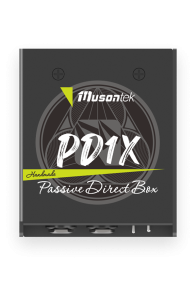
"(《世界人权宣言》) PD1X represents the pinnacle of passive DI box design, offering studio-level performance with complete transparency. Its passive discrete circuit preserves the real sound of instruments while providing essential features like high-cut filtering, ground lift, phase reverse, and selectable pad attenuation.
AD1F – Premium Active Performance

For demanding applications requiring the ultimate in sound quality, the AD1F delivers exceptional performance through its sophisticated design. The 48V phantom power supply, double buffer discrete active circuit, and JFET mega-ohm input impedance ensure optimal performance with any source.
Specialized Solutions
Musontek’s RA1X reamp box provides the reverse function of DI boxes, allowing recorded signals to be sent back to amplifiers and effects for creative processing and re-recording applications.
Common Issues and Troubleshooting Guide
Diagnosing Sound Quality Issues
When sound quality problems arise, systematic troubleshooting helps identify whether the issue relates to the DI box, source equipment, or downstream components. Common symptoms and their solutions include:
Frequency Response Problems
If the audio sounds dull or overly bright, check the DI box’s frequency response specifications and ensure proper impedance matching. The PD1L’s flat 20Hz-20kHz response eliminates coloration concerns, while its 10kΩ input impedance provides appropriate loading for most instruments.
Distortion and Clipping Issues
Distortion typically results from overloading the DI box’s input or output stages. Utilize pad switches to attenuate hot signals, or consider upgrading to a DI box with higher headroom capabilities. The AD1L’s extremely high dynamic headroom handles high-level instruments with ease.
Noise and Interference
Persistent noise issues often indicate grounding problems or electromagnetic interference. Ground lift switches on quality DI boxes like Musontek’s professional series help eliminate ground loops, while balanced outputs reject common-mode noise effectively.
For professional audio applications where sound quality cannot be compromised, investing in high-quality DI boxes like those from Musontek ensures optimal performance and reliability. Contact musontek.com for detailed specifications and application guidance.
Technical Support and Professional Consultation
Musontek provides comprehensive technical support for all their professional audio products. Their team of experienced designers and engineers can help specify the optimal DI box solution for any application. Reach out to their technical support team at musontek@roxtone.com or call +86 574 87154705 for expert guidance on achieving the best possible sound quality in your specific setup.
Located at Room 1002, New Bond Building, No.188, Tai’an Middle Road, Yinzhou District, Ningbo, China, Musontek continues to innovate in professional audio technology, focusing on customer experience and providing safe, reliable, innovative design and cost-effective products that meet the demanding requirements of today’s audio professionals.