
A delay pedal repeats what you play, creating echoes that make your guitar sound bigger and more interesting. You hear your notes bounce back, filling the room with depth and space. When paired with a buffer guitar pedal like the MusonTek Adjudicator, your signal stays clear and consistent, ensuring the delay effect remains rich and expressive.
-
Delay pedals can make your guitar sound like it’s in a large hall.
-
They help you stand out in a band or add dreamy layers to your music.
-
Using a buffer guitar effect keeps your sound clear, even with lots of pedals.
|
Genre |
Why Use a Delay Pedal? |
|---|---|
|
Rock |
Adds energy and creative textures |
|
Ambient |
Builds immersive, spacious soundscapes |
|
Electronic |
Creates cool, atmospheric effects |
Key Takeaways
-
Delay pedals make echoes that help your guitar sound larger and fuller. They can make your music feel more exciting and deep.
-
A buffer pedal helps your guitar signal stay strong and clear. It stops your sound from getting weak, even if you use many effects.
-
Try out different delay settings to find cool sounds you like. This helps you match the effects to your own way of playing.
Delay Pedal Basics
How Delay Pedals Work
A delay pedal takes the sound from your guitar and repeats it after a short pause. You can think of it like shouting in a canyon and hearing your voice bounce back. The delay effect happens because the pedal records your note, waits a set amount of time, and then plays it back. Most delay pedals let you choose how long to wait before the repeat. This time is measured in milliseconds, so you can make the repeat almost instant or stretch it out for a long echo.
Here are the main controls you will find on a delay pedal:
-
Time: This sets how long the pedal waits before playing back your note. You can make the delay effect short and snappy or long and dreamy.
-
Feedback: This controls how many times the sound repeats. A low setting gives you just one or two repeats. A high setting can make the sound repeat over and over.
-
Mix / Level: This lets you blend your original guitar sound with the delayed sound. You can make the delay effect subtle or very obvious.
Delay pedals come in two main types: analog and digital. Digital delay pedals record your guitar sound, turn it into digital information, and store it in memory. This gives you clear and clean repeats. Analog delay pedals use special chips to copy your sound. Each repeat gets a little darker and loses some high notes, which can make your playing sound warm and vintage.
“If audio could be digitized with high enough fidelity, it could be stored as digital bits, converted back to analog and, voila, you would have achieved delay – in real time, with no moving parts.” — Tony Agnello
Over the years, delay pedal technology has changed a lot. Early pedals used analog chips, but digital pedals became popular because they sound clear and offer more options. Today, you can find both types, each with its own special sound.
Here’s a quick look at how delay times can vary:
|
Pedal Name |
Maximum Delay Time (ms) |
Minimum Delay Time (ms) |
|---|---|---|
|
Memory Boy |
550 |
0-30 |
Core Effects: Echo and Ambience
The delay effect does more than just repeat your notes. It adds depth and space to your guitar sound. When you use a delay pedal, your playing can feel like it’s happening in a big room or even a concert hall. This makes your music sound fuller and more interesting.
-
Delay pedals make your guitar sound bigger by adding repeats that fill in the gaps between notes.
-
The delay effect can create a sense of space, making it feel like you are playing in a larger area.
-
You can use the delay effect to make your solos stand out or to add a dreamy background to your chords.
Some players use the delay effect before reverb to make their sound even softer and more atmospheric. The delay pedal can also help you create special effects, like the classic echo effect you hear in old rock and roll songs.
Delay pedals are popular in many styles of music. In rock and metal, they add power and energy. In jazz, a quick slapback delay effect can make single notes pop. In ambient and worship music, long repeats and lush textures help build emotional soundscapes.
Tip: Try turning the feedback knob up for more repeats, or the mix knob higher for a stronger delay effect. You can experiment with different settings to find your favorite sound.
The delay effect is a simple tool, but it can change the way your guitar sounds in amazing ways. You can use it to add texture, create space, or just have fun with new sounds.
Buffer Guitar Effect and Signal Clarity
What Is a Buffer Pedal?
Sometimes your guitar can sound dull with long cables or many pedals. This is when the buffer guitar effect helps. A buffer pedal is like a helper for your sound. It keeps your guitar signal strong and clear. Even if your setup is big, your sound stays bright.
-
A buffer pedal is a small preamp that boosts your signal.
-
It changes your guitar’s high-impedance signal into a low-impedance one.
-
This helps your sound travel farther without losing quality.
-
The buffer guitar effect is important if you want to avoid “tone suck,” which makes your guitar tone weak.
The Musontek Adjudicator is a good buffer pedal. It keeps your sound crisp and clear. Your guitar can stand out, even with lots of delay units or other effects.
The length of a guitar cable matters for your sound. If the cable is long and not buffered, it can change your tone. More cable means more capacitance, which affects your sound. High frequencies can get lost, and your tone can sound different. This change is easy to hear, even with regular guitar speakers. It can really change how your guitar sounds.
Why Use a Buffer with Delay?
When you use delay units, you want every repeat to sound clear. The buffer guitar effect helps your delay pedals get a strong signal. This keeps the echoes bright and full. Here’s why many guitarists use a buffer with delay:
-
The buffer guitar effect keeps your signal quality high, even with long cables.
-
It stops high-end loss, so your delay units sound bright and lively.
-
Buffers let delay repeats fade out naturally, which makes your playing sound smooth.
-
Placing a buffer before or after your delay pedal can help you find the best sound for your setup.
-
The buffer guitar effect works well with other pedals, making your whole board sound better.
If you want your delay units to sound great and your guitar tone to stay strong, try a buffer pedal like the Musontek Adjudicator. It can really help your sound.
Using a Delay Pedal: Practical Tips
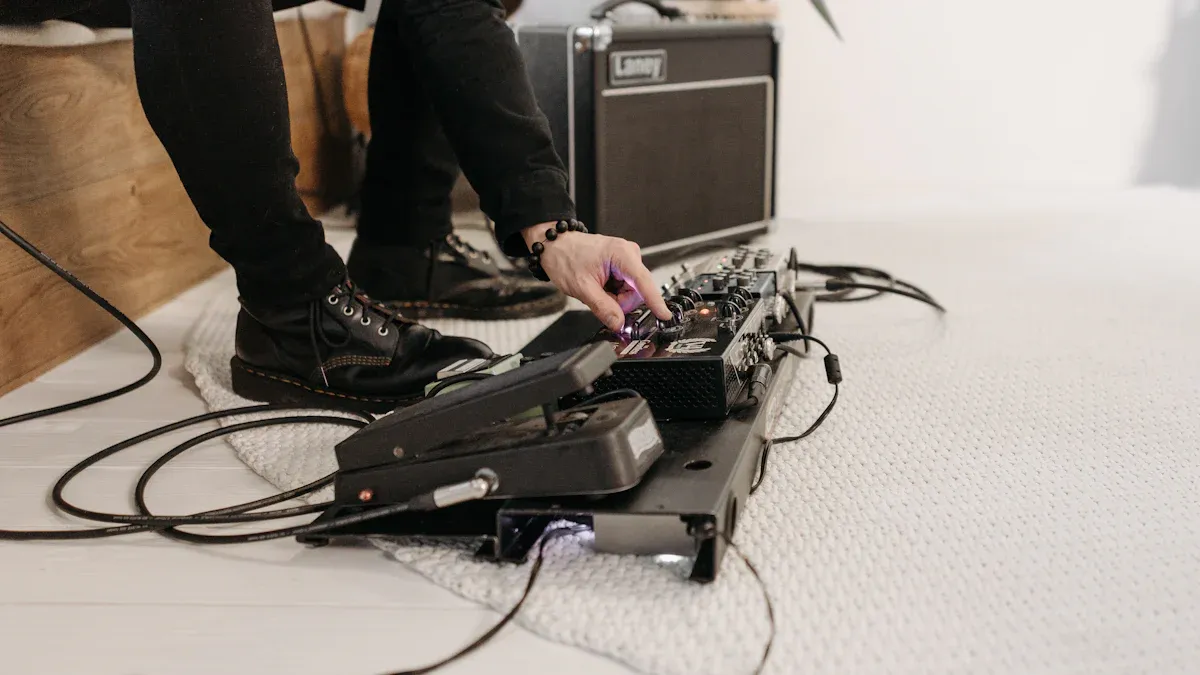
Delay in Rhythm and Solos
A delay pedal can make rhythm playing more fun. Guitarists use delay to fill empty spots in songs. This helps music sound full and makes the guitar stand out. Try soft delay types to make your sound thicker. This way, you keep the timing right. When you play solos, delay pedals can make cool effects. Slapback delay gives a fast echo. It works well for country and rockabilly. Longer delay types make dreamy sounds for ambient music. Some players use reverse delay for wild and strange effects.
-
Delay pedals add style and groove to rhythm parts.
-
They make solos sound bigger and more fun.
-
Slapback delay (about 110ms) is good for country and rockabilly.
-
Longer delay types add depth to solos in ambient and post-rock.
Analog vs. Digital Delay
You may wonder about analog and digital delay types. Here is a quick look:
|
Feature |
Analog Delay |
Digital Delay |
|---|---|---|
|
Sound Quality |
Warm, rich, slightly degrading |
Crisp, clean, consistent |
|
Functionality |
Unique sound on each repeat |
MIDI control, high fidelity |
|
Noise Levels |
Lower noise, keeps dry signal |
May add noise, possible latency |
|
Ideal Use |
Organic, unpredictable repeats |
Accurate, reliable repeats |
Analog delay pedals give warm, old-school delay sounds. Digital delay pedals give clear repeats and extra features. Some digital pedals keep your dry sound the same. This way, you get both clear and classic sounds.
Getting Started with Delay Settings
If you are new to delay pedals, start simple. Put your delay pedal after chorus for clean repeats. Try different settings to see what you like. Do not use too many pedals at once. Plan your pedal setup and think about what you may want later. Try different delay types and styles to find new sounds.
Tip: Do not make your setup too hard. Learn how each delay pedal works before adding more effects.
You get a richer guitar sound when you use delay and buffer pedals. Delay adds depth, texture, and movement. Buffer keeps your tone clear. Many players say delay is a must-have. Try different pedal setups and settings. You might discover new styles and sounds that inspire your playing.
FAQ
How do you set up a delay pedal on your pedalboard?
You put the delay pedal near the end of your chain. This way, you hear clear repeats after other effects like distortion or chorus.
Do you need a buffer pedal with a delay pedal?
If you use long cables or lots of pedals, a buffer pedal helps your sound stay bright. You get better tone and clearer repeats.
Can you use delay for both rhythm and solos?
Absolutely! Delay adds groove to rhythm parts and makes solos sound bigger. Try different settings to find what works best for your style. 🎸