An EQ pedal lets bass players control their sound by adjusting certain frequencies. Players can boost or cut low, mid, or high tones to make their bass stand out or blend in. Graphic EQs give players precise control over each frequency band. Parametric EQs allow even more detailed adjustments, letting players change the width and strength of each band. These tools help create a clear and powerful bass tone that fits any music style.MusonTek Эквалайзер Гитарный эффект–Ремоудел can match your needs.Key Takeaways
-
An EQ pedal lets bass players change sound frequencies. This helps them make a sound that matches their style and music. Boosting or lowering certain frequencies can fix bass problems. These problems include muddiness or not being heard in a mix. Small EQ changes often make the sound clearer and more balanced. Different music styles need different EQ settings. Players should try different settings to see what works for their music. EQ pedals make bass more flexible. They help players keep the same sound with different instruments and shows.
EQ Pedal Basics for Bass

Frequency Controls: Bass, Mid, Treble
Bass guitars produce sounds in a range from about 40Hz to 400Hz. This range covers the deep, low notes that give the bass its power. An EQ pedal helps players adjust these frequencies to get the best sound for their style and setup.
Most EQ pedals for bass have controls for bass, mid, and treble. Each control changes a different part of the sound. The table below shows the standard frequency ranges for each control and what they do:
|
Control |
Frequency |
Описание |
|---|---|---|
|
Bass |
75Hz |
Affects the bottom end, can make it boomy. |
|
Low Mid |
150Hz |
Adds fullness and body, can fatten or thin sound. |
|
Midrange |
500Hz |
Adjusts the ‘sizzle’ and overall presence. |
|
High Mid |
1.5kHz |
Affects attack, making it more or less pronounced. |
|
Treble |
3 кГц |
Affects high-end harmonics, excessive boosting can be harsh. |
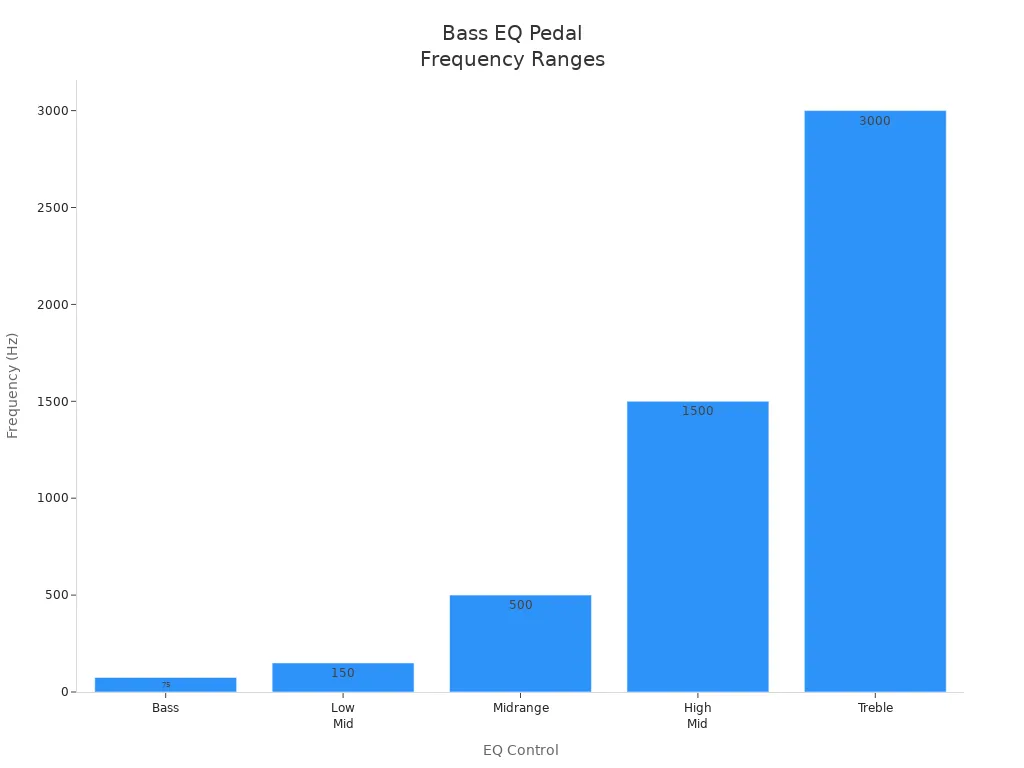
These controls let players shape their tone. For example, boosting the bass knob can make the sound deeper and heavier. Cutting the treble can remove harshness and make the tone smoother.
Tone Shaping with EQ Pedals
An EQ pedal gives bassists the power to change their sound for different songs or playing styles. Small changes can make a big difference. Players often use the pedal to solve problems or highlight certain parts of their tone.
-
If the bass sounds thin or weak, boosting the low end or cutting the treble can help.
-
Cutting a frequency is often more effective than boosting another. For example, if the sound is too boomy, cutting the bass instead of boosting the mids can clear it up.
-
A mid scoop, which means cutting the midrange while boosting bass and treble, creates a sharp tone. This works well for slap bass.
-
Boosting low mids (around 250-500Hz) can help the bass stand out in a band mix.
-
Subtle changes work better than big boosts. Too much boosting can make the sound muddy or harsh.
Tip: Avoid boosting all the controls at once. This can make the sound messy. Try small cuts or boosts to find the best tone.
Different EQ pedal designs also affect how players shape their sound. The table below compares two common types:
|
EQ Type |
Strengths in Shaping Bass Tone |
|---|---|
|
Графический эквалайзер |
Effective for notching out specific frequencies |
|
Параметрический эквалайзер |
Offers flexibility and precision for broader adjustments |
A graphic EQ pedal lets players adjust set frequency bands. This works well for fixing problem spots in the sound. A parametric EQ pedal gives more control, letting players choose which frequency to adjust and how wide the change will be. Both types help bassists find their perfect tone.
Solving Bass Tone Issues

Common Problems and EQ Solutions
Bass players often face challenges with their sound. Sometimes the bass gets lost in the mix, or it sounds muddy and unclear. An EQ pedal helps solve these problems by allowing players to adjust specific frequencies. They can cut frequencies that overlap with other instruments and boost areas that make the bass stand out.
-
Precise frequency adjustments help avoid clashes with guitars, keyboards, and drums.
-
Cutting overlapping frequencies keeps the bass clear and prevents muddiness.
-
Boosting key areas adds presence and helps the bass support the music.
Players often target these frequency ranges for better results:
-
80 Hz to 200 Hz adds energy and fullness.
-
200 Hz to 500 Hz can cause muddiness, so cutting here cleans up the sound.
-
500 Hz to 1 kHz brings punch and makes the bass more understandable.
-
1 kHz to 5 kHz controls attack, harmonics, and clarity.
Tip: Small changes in these ranges can make a big difference in how the bass fits with other instruments.
Fitting Bass in the Band Mix
A band mix includes many instruments, each with its own frequency space. The bass must fit in without fighting for space. EQ pedals help bass players find the right spot in the mix.
-
EQ pedals enable players to shape their sound so it does not clash with guitars or keyboards.
-
Maintaining clarity in the mix keeps the bass from muddying the overall sound.
Bass and guitar EQ pedals have important differences. The table below shows how their frequency ranges compare:
|
Type of EQ Pedal |
Диапазон частот |
|---|---|
|
Six Band (Guitar) |
100Hz to 3kHz |
|
Ten Band (Bass) |
31.25Hz to 16kHz |
Bass EQ pedals cover lower frequencies, which are essential for bass instruments. Guitar EQ pedals focus on higher ranges. For guitar, a high pass filter at 100Hz cleans up the tone and keeps it from overlapping with the bass. This careful frequency management helps each instrument sound clear and powerful.
Using an EQ Pedal Effectively
Setup and Controls
Setting up an EQ pedal for bass requires careful attention to both the pedal’s controls and its placement in the signal chain. Many players start by placing the EQ pedal early in the chain. This position helps preserve the low-end frequencies, especially when using distortion or fuzz effects. Some players prefer to place the EQ pedal at the end of the chain. This method allows them to balance the entire signal before it reaches the amplifier.
Here are recommended steps for setting up an EQ pedal with bass:
-
Apply a high pass filter around 20-40Hz to clean up unwanted rumble.
-
Identify the kick drum’s main frequency and create a notch in the bass EQ to avoid overlap.
-
Boost the fundamental frequency near 100Hz for a thicker sound.
-
Cut frequencies in the 300-400Hz range to reduce muddiness.
-
Boost upper frequencies between 4-6kHz to add presence and clarity.
-
Roll off frequencies above 7kHz to keep the high end clean.
Tip: Avoid over-EQing. Sometimes, the best sound comes from knowing when not to use EQ.
Tips for Different Styles
Bass players use EQ pedals to shape their sound for different genres and situations. Each style benefits from unique settings and approaches.
-
Rock and metal players often boost the low end and upper mids for punch and aggression.
-
Funk and slap bass styles sound best with a mid scoop, boosting bass and treble while cutting mids.
-
Jazz and blues players may prefer a balanced EQ, with gentle boosts to low mids for warmth.
Common mistakes include over-EQing and relying too much on EQ for excitement. Harmonic distortion can add energy to the low end without making the sound tubby. Players should also create space for the bass by panning other instruments away from the center. Bass can work in both stereo and mono mixes, allowing for creative arrangements.
|
Style |
Suggested EQ Settings |
|---|---|
|
Rock/Metal |
Boost 100Hz, boost 1-2kHz, cut 300Hz |
|
Funk/Slap |
Boost bass/treble, cut mids |
|
Jazz/Blues |
Gentle boost low mids, smooth highs |
Note: Small changes in EQ settings often produce the best results. Listen carefully and adjust as needed for each song.
Benefits of EQ Pedals for Bass
Clarity and Presence
Bass players want their sound to be clear and easy to hear. An EQ pedal helps them do this by letting them change certain frequencies. Players can make their bass stand out in a mix by cutting sounds that fight with other instruments. This makes the music sound better together. Boosting some frequencies makes each note sharper and easier to hear. This control keeps the bass strong but not too loud.
Tip: Even small changes in EQ can really help clarity. Listen closely when you change the settings.
Many bassists use EQ pedals to control how loud or soft their sound is. They can boost or cut parts of the sound to fit in with the band. This stops the bass from getting lost or being too loud. Changing the tone quickly helps players keep up with different songs.
-
Changing frequency ranges helps balance the sound.
-
Cutting fighting frequencies makes the music blend better.
-
Boosting important frequencies makes the bass clearer.
-
Controlling loudness helps the bass fit in the mix.
Versatility and Control
EQ pedals give bass players lots of choices. They can make different bass guitars or pickups sound even. This makes switching instruments easy during a show. Players can change their sound to match each bass, so the volume and tone stay the same.
-
Careful tone changes help keep the sound even.
-
Changing frequencies lets players match their sound on any instrument.
EQ pedals also help players be creative. They can try new settings to make cool effects or their own special sound. Using EQ pedals with other effects gives more ways to show their style. Each player can find their own sound by trying different things.
-
EQ pedals and other effects change the sound a lot.
-
Many effects help players show their own style.
-
Trying new ideas can make the bass sound special.
A good EQ pedal lets bassists change their tone fast. They can play any kind of music or handle any show. This makes the pedal a great tool for live shows and recording in the studio.
An EQ pedal lets bassists change their sound for any song. Experts say a few things are important:
-
Effects pedals help bassists try new tones and styles.
-
A good sound can make playing and practice more fun.
Players find their favorite sound by testing settings:
-
Turning down treble gives a classic sound.
-
Cutting mids is great for slap bass.
-
Boosting mids makes the sound stronger.
-
Every player should try things to see what works.
|
Future Trends in Bass EQ Pedals |
|---|
|
AI and machine learning will make effects smarter |
|
More people want custom and special pedal choices |
|
Making pedals eco-friendly is becoming important |
|
More music styles are using bass pedals |
Every bassist can find their own sound by trying out an EQ pedal.
ЧАСТО ЗАДАВАЕМЫЕ ВОПРОСЫ
What is the main purpose of an EQ pedal for bass?
An EQ pedal lets bass players change their sound by adjusting certain frequencies. This helps the bass fit better in a band and makes the tone clearer.
Can a guitar EQ pedal work for bass?
A guitar EQ pedal can work, but it may not cover the deep bass frequencies. Bass EQ pedals reach lower frequencies, which helps shape the true bass sound.
Where should a bass EQ pedal go in the signal chain?
Most players place the EQ pedal early in the chain, before effects like distortion. Some put it last to shape the final sound. Both ways work.
Do EQ pedals replace the amp’s tone controls?
EQ pedals do not replace amp controls. They give extra control and let players make quick changes. Players use both together for the best sound.