Ground loop isolators help remove unwanted noise in audio systems. They make the sound clearer and easier to hear. These devices break the electrical connection between equipment. This stops hums and buzzing sounds. Мусонтек ISO2C is a great choice because it supports two channels. It also gives studio-level performance. If you hear ground loop noise, check your setup first. You can use a ground loop isolator to help fix it. Using a ground loop isolator can make music and voices sound better. It can improve your listening experience.
Isolators stop the connection that lets unwanted noise get into your audio system. Many people hear ground loop noise as a hum or buzz. This makes music or guitar sounds unclear. This noise can come from many places and can ruin how you hear things. Here is how these noises change audio quality:
|
Type of Noise |
Влияние на качество звука |
|---|---|
|
Ground Loop Noise |
Brings in unwanted electrical sounds. This causes distortion and makes sound less clear. |
|
Electromagnetic Interference (EMI) |
Messes up audio signals. This causes distortion and lowers sound quality. |
|
Signal Path Noise |
Hurts how the audio works. You need isolation for clear sound. |
A ground loop isolator helps by stopping the hum. It lets the real sound come through. This makes it a favorite tool for guitarists and people who love audio.
Что такое изолятор контура заземления?

Purpose and function
A ground loop isolator is a small device. It helps keep sound clear by stopping hums and buzzes. It breaks the electrical link between equipment. This keeps ground loop noise out of your music. People use ground loop isolators to keep sound clean.
The main job is to separate input and output circuits. It uses isolation transformers for this. These transformers let audio signals pass but block ground loop noise. When devices have different ground points, noise can get in. The isolator disconnects these points, so noise cannot reach speakers.
Musontek ISO2C is a good example of a dual channel audio isolator. It uses studio-grade isolation transformers to keep sound pure. The ISO2C works with balanced and unbalanced signals. It fits many setups. Users like that it works right away. Just plug it in and listen. The ISO2C protects your audio system and keeps sound clear.
Here is a quick look at how Musontek ISO2C compares to other isolators:
|
Характеристика |
Musontek ISO2C |
Other Isolators |
|---|---|---|
|
Signal Support |
Сбалансированный/несбалансированный |
Варьируется |
|
Искажение |
Низкий |
Higher in some |
|
Диапазон частот |
Wide |
Limited in some |
|
Динамический диапазон |
Высокий |
Варьируется |
|
Изоляционные трансформаторы |
Студийный класс |
Стандарт |
Common audio and guitar uses
People use ground loop isolators in many places. These devices help keep sound clean in home audio systems. They also help in car audio setups and studios. Musicians and guitarists often have ground loop noise. This happens when they connect amps, pedals, and gear. A ground loop isolator can fix this problem fast.
Some common causes of ground loop noise include grounding issues. Plugging amps into the same circuit can cause problems. Power supply issues, especially with non-isolated power supplies, add noise. Electronic devices nearby, like TVs or computers, can also add noise.
Ground loop isolators help by stopping hum and buzz. Guitarists use them to remove 60/50Hz ground loop hum. They also use isolation transformers to block high-frequency noise. This is helpful with USB connections. In studios, ground loop isolators keep recordings clean.
People can find different types of ground loop isolators. Some cost as little as $9.99. Others have more features and cost more. The average price is about $16.99. Some models go up to $25.49. Musontek ISO2C stands out. It offers dual channel support and studio-grade performance. This makes it a top choice for reliable sound.
Tip: If you hear a hum or buzz in your audio system, try a ground loop isolator. It can make your sound much better.
How does a ground loop isolator work?

Breaking ground loops
A ground loop isolator stops unwanted electrical currents between devices. These currents make a hum or buzz in your audio system. When two devices have different ground levels, a ground loop can start. This causes noise and interference.
People use ground loop isolators to break this link. The device makes a barrier between input and output. It does not let current move straight from one side to the other. It lets the audio signal go through but blocks the noise. This keeps your sound clean and clear.
Here are the main points about how ground loop isolators work:
-
Ground loops start when devices have different electrical levels.
-
Unwanted current moves between devices and makes noise.
-
Ground loop isolators make a barrier and stop the current.
-
The isolator keeps the audio signal but removes the noise.
Musicians and audio engineers hear ground loop noise when they connect many devices. A ground loop isolator lets only the music pass, not the hum.
Magnetic isolation and transformers
The main part of a ground loop isolator is the isolation transformer. This part uses magnets to move audio signals. There is no direct electrical path between input and output. The transformer has two coils: a primary and a secondary. When an audio signal goes into the primary coil, it makes a magnetic field. The secondary coil picks up this field and turns it back into sound.
This way, direct current cannot get through, only alternating current can. The transformer blocks ground loop noise but lets music and voices pass. Isolation transformers do not need outside power. They are strong, simple, and work well. They also keep your gear safe from power surges.
Some ground loop isolators have extra parts inside. Inductors, like common-mode chokes, help stop unwanted currents and lower electromagnetic interference. Capacitors change the resistance and help control noise at different sound levels. Inductors and capacitors together can make resonance, which changes how the device handles noise.
Musontek ISO2C uses high-quality isolation transformers for the best sound. The device works with both balanced and unbalanced signals. It fits stereo systems and dual-microphone setups. Users like that you just plug in the ISO2C and it works right away.
Here is a table with the technical details of Musontek ISO2C’s isolation transformers:
|
Технические характеристики |
Value |
|---|---|
|
Total harmonic distortion |
0,001% @ 1 кГц, выход +4dBu |
|
Phase Deviation |
0,5° @ 100 Гц; 37° @ 20 Гц |
|
Dynamic range |
135 дБ |
|
Frequency response |
20 Гц - 20 кГц (±0,3 дБ) |
|
Входной импеданс |
600Ω, небалансный и балансный |
|
Output Impedance |
600Ω, сбалансированный |
|
Number of channels |
Стерео (двойное моно) |
|
Максимальный вход |
+21dBu @ 1kHz, 1% THD+N |
Note: Musontek ISO2C does not need outside power. It works right away and keeps your sound pure.
A ground loop isolator works by using these smart transformers and good circuit design. The result is a device that removes ground loop noise and keeps your music sounding great.
Изоляторы контуров заземления и качество звука
Effectiveness in removing noise
Ground loop isolators help stop ground loop noise in many places. They break the link that causes hums and buzzes. People use them at home, in studios, and at concerts. Most people hear less unwanted sound after using one. Some notice static noise goes away, but other sounds like alternator whine can stay. Sometimes, the isolator does not fix every problem. This happens if the trouble comes from broken gear or bad wires.
|
User Experience |
Outcome |
|---|---|
|
User 1 |
Static noise got better, but alternator whine stayed. |
|
User 2 |
Noise did not go away, so more checking was needed. |
|
User 3 |
Isolator did not help; the DSP was broken. |
Most people get good results if ground loop noise is the main problem. If the noise comes from somewhere else, they should check other parts of their system.
Impact on audio fidelity
Ground loop isolators help keep music and voices clear. They remove hums and buzzes. Sometimes, they change the sound a little. Some people hear lower volume or less bass. Others say music loses some detail. These changes happen because the isolator blocks noise but also affects the signal.
-
Ground loop isolators can lower unwanted noise.
-
They might make small changes to sound, like less bass.
-
Some people notice less detail or lower volume.
Tests show the frequency response can change. For example, after using an isolator, the -3 dB point moves from 2.8 Hz to about 46 Hz. Sounds below 2.2 kHz get weaker. The music may sound less full, like a low-quality system. Harmonic distortion can also go up, making the sound less clean.
|
Frequency (kHz) |
Amplitude (dBV) Before GLI |
Amplitude (dBV) After GLI |
|---|---|---|
|
17 |
-100 |
-89 |
|
18 |
-95 |
-74 |
|
21 |
-98 |
-76 |
|
22 |
-99 |
-92 |
Limitations and drawbacks
Ground loop isolators work well for ground loop noise, but they have limits. They may not fix every sound problem. If the trouble comes from broken gear or bad cables, the isolator cannot help. Some people hear lower volume or less bass. Others find the isolator does not work with all gear. People should check their system and make sure the isolator is right for them.
Tip: If ground loop noise is your main problem, try a ground loop isolator. For other issues, check your cables and devices first.
When to use a ground loop isolator
Identifying ground loop noise
People sometimes hear weird sounds in their audio or guitar gear. These sounds can make music or talking hard to hear. Ground loop problems often show up as a low hum or buzz from speakers or amps. Sometimes, you might hear a high squeal when using effect pedals. A common sign is a 60Hz hum. This happens when current moves through different ground wires.
Here are some usual signs of ground loop noise:
-
Low buzzing or humming from speakers or amps
-
High squeal when using effect pedals
-
60Hz hum that stays even after switching cables
To find where the noise comes from, audio engineers follow easy steps:
-
Turn off all gear and look for broken cables.
-
Unplug devices and plug them back in one at a time.
-
Take away extra gear to see if the noise stops.
-
Use just one power source for all your gear.
-
Try new cables to see if the old ones are bad.
-
If the hum or buzz is still there, try a ground loop isolator.
People should check every part of their setup. Checking each step helps find what is really wrong. If the hum does not go away, a ground loop isolator can help.
Choosing the right isolator
Picking the best ground loop isolator depends on what you need. Guitar players want high input impedance to keep their sound clear. This is important with passive pickups. A ground lift switch can get rid of hum from ground loops. Some isolators have a phase reverse switch. This helps when using more than one mic or amp. A tough case helps the device last longer in studios or on stage. Transformer isolation blocks noise from other gear.
Here is a table that shows what to look for in a ground loop isolator:
|
Характеристика |
Описание |
|---|---|
|
High Input Impedance |
Keeps guitar sound clear, good for passive pickups |
|
Выключатель подъема грунта |
Gets rid of hum from ground loops |
|
Phase Reverse Switch |
Fixes sound problems with more than one mic or amp |
|
Robust Build |
Strong for live shows and studio use |
|
Transformer Isolation |
Blocks noise and interference |
A dual channel ground loop isolator like Musontek ISO2C is good for stereo systems or setups with two audio paths. It works with both balanced and unbalanced signals. The plug-and-play design makes it easy to use. Musontek ISO2C fits studios, live shows, and home audio systems. People who need to fix ground loop noise in more than one channel should pick a dual channel model.
Tip: If you hear a hum or buzz in both left and right speakers, a dual channel ground loop isolator can fix the problem fast.
Ground loop isolators help people get clear sound by stopping hum and buzz. They make music and voices sound better. This helps you enjoy listening more.
-
Put the isolator between the head unit and amplifier for best sound.
-
Use short, thick ground wires. Keep signal cables away from power wires.
Musontek ISO2C is known for being reliable and working well.
|
Технические характеристики |
Musontek ISO2C |
Other Brands |
|---|---|---|
|
Частотная характеристика |
±0.3dB (20Hz-20kHz) |
±1dB to ±3dB |
|
Динамический диапазон |
>130 дБ |
>100 дБ |
|
Максимальный вход |
+21dBu |
+15dBu |
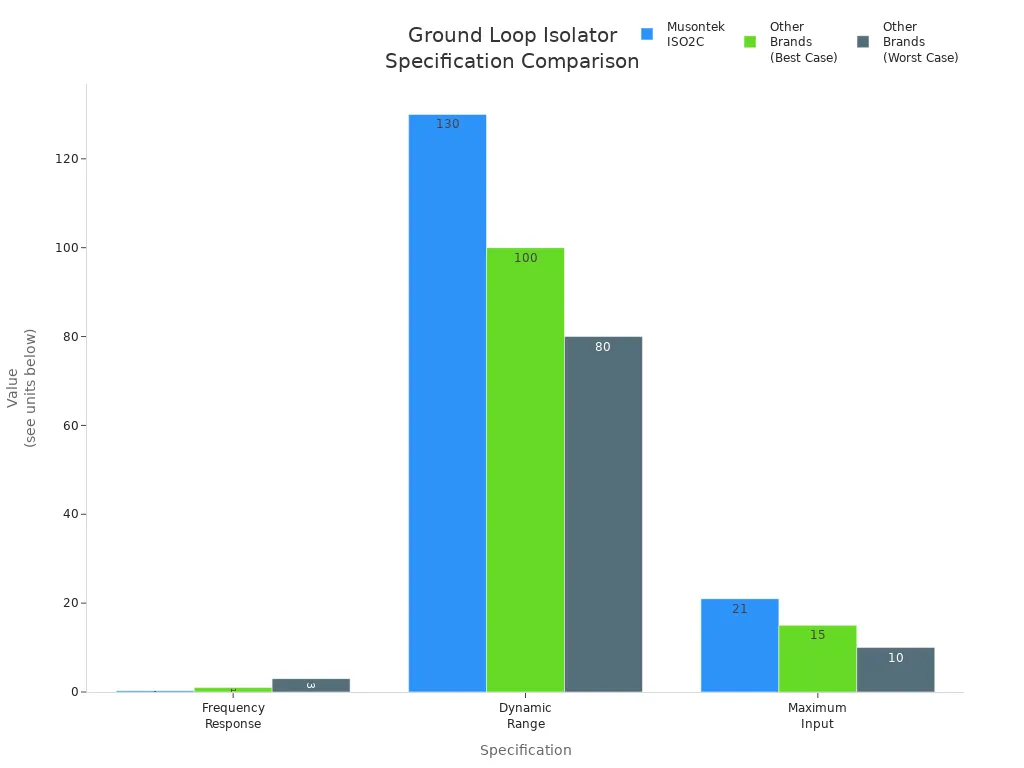
Using a ground loop isolator quickly breaks the loop and stops noise. You might lose a little bit of signal.
ЧАСТО ЗАДАВАЕМЫЕ ВОПРОСЫ
What causes ground loop noise in audio systems?
Ground loop noise starts when devices use different ground points. This makes unwanted electrical currents. People hear a hum or buzz in speakers or amps.
Can Musontek ISO2C fix noise in both home and studio setups?
Yes, Musontek ISO2C works for home audio and studios. It supports balanced and unbalanced signals. Users just plug it in and get clear sound.
Does a ground loop isolator need power to work?
No, ground loop isolators like Musontek ISO2C do not need outside power. The device uses transformers to move audio signals with magnets. Users just plug it in and it works.
How do you know if you need a ground loop isolator?
People should listen for hums or buzzes that stay after changing cables. If the noise is still there, a ground loop isolator can help. Musicians and audio fans use them for clean sound.
Will a ground loop isolator affect sound quality?
Most people hear clearer sound after using an isolator. Some may notice small changes in bass or volume. Musontek ISO2C uses studio-grade transformers to keep music and voices clear.