If you want the most versatile equalizer guitar effect, you should check out the Musontek Remeowdel. Many players also rank the Boss GE-7 among the top picks for shaping guitar tone and dialing in your sound. Here’s a quick look at one of the top picks:
Rank | Gear |
|---|---|
3 | Boss GE-7 7-Band EQ Pedal |
Picking the best eq pedals for your rig comes down to matching your options to your style and sound goals. A good equalizer is an essential piece of equipment for every player. Use this product guide for buying advice, eq settings, and options. Get buying advice for top picks, product guide tips, and options that match your sound. You’ll discover product guide ideas and buying advice that make choosing eq pedals easy.
Principais conclusões
Um EQ pedal is important for changing your guitar sound. It lets you make some sounds louder or quieter. This helps you get the sound you want.
Pick either a graphic or parametric EQ pedal for your needs. Graphic EQs are easy to change quickly. Parametric EQs let you control your sound more.
Think about how strong the pedal is and how it gets power. A tough pedal with many power choices works well on stage.
Choose an EQ pedal that fits your way of playing and music style. Different ways of playing need different EQ settings for the best sound.
Try out different EQ pedals with your own gear. Each pedal works in its own way with your amp and effects. Find the one that sounds best with your setup.
Why Use an Equalizer Guitar Effect?
Modelação do tom
You want your guitar to sound just right. An eq pedal gives you the power to shape your sound in ways that other pedals cannot. With an equalizer, you can boost or cut certain frequencies to make your guitar stand out or blend in. This means you can add sparkle to your highs, punch to your mids, or warmth to your lows.
EQ pedals give you specific control over your sound.
You can break down the frequency range into smaller bands for detailed tone-shaping options.
Many guitarists use eq pedals to balance the output between different guitars.
When you use an eq pedal, you can boost or cut the mid-range, which is where most of your guitar’s character lives. This helps you find your unique voice. You can also boost or cut the highs or lows to match your amp or the room you play in. If you want to refine your overall tone, an eq pedal is a must-have. It lets you boost or cut frequencies to improve your sound quality and get creative with your music.
Live Performance Benefits
Playing live brings new challenges. Sometimes your guitar gets lost in the mix, or maybe it sounds too harsh. An eq pedal helps you fix these problems fast. You can boost or cut frequencies on the fly, making sure your guitar always sounds great on stage.
EQ pedals are essential for any pedalboard setup, especially for live use.
You can combine eq pedals with other effects for even better results.
They let you boost or cut certain frequencies to fit your band’s sound.
If you switch guitars during a show, an eq pedal helps you balance the output so every guitar sounds its best. You can also use it as a clean boost, giving your solos extra volume and clarity. With an eq pedal, you stay in control, no matter what the stage throws at you.
Key EQ Pedal Features
Bands and Controls
When you look at eq pedals, you’ll notice two main types: graphic eq and parametric eq. A graphic eq uses sliders to control fixed frequency bands. You can see exactly how you shape your sound. A parametric eq gives you more control. You can pick the frequency, adjust the width, and set the boost or cut. Many players like graphic eq pedals for quick changes on stage. Parametric eq pedals work well if you want to fine-tune your sound.
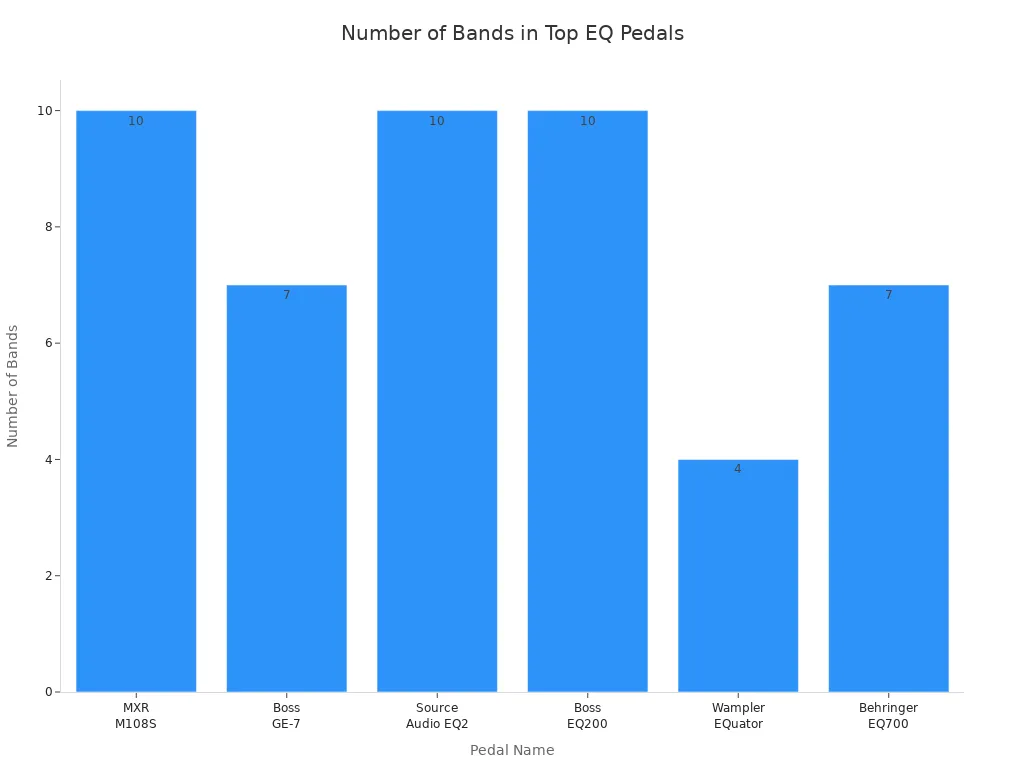
Here’s a quick table to show how the number of bands and controls can vary:
Nome do pedal | Number of Bands | Opções de controlo |
|---|---|---|
MXR M108S | 10 | 10 sliders, -12dB to +12dB |
Boss GE-7 | 7 | 7 sliders for low, mid, high control |
Source Audio EQ2 | 10 | Programmable, 4 preset slots, +/- 18dB |
Boss EQ200 | 10 | 10-band EQ, +/- 15dB per band |
Wampler EQuator | 4 | Knobs for low, mid, treble |
Behringer EQ700 | 7 | 7 bands, +/- 15dB, 100Hz to 6.4kHz |
You can use a graphic eq to boost your mids for solos or cut harsh highs. A parametric eq lets you target problem spots in your tone. Both types unlock new sounds and help you match your guitar to any mix.
Build and Power
You want your eq pedal to last. Build quality matters a lot. Metal casings protect your pedal from drops and bumps. Many top graphic eq pedals, like the MXR Ten Band EQ, use aluminum housings. Boss pedals have a reputation for being tough. If you play gigs, you need a pedal that can handle the road.
Tip: Always check the power options. Some eq pedals run on batteries, while others need a power supply. A pedal with flexible power options fits better on your board.
A solid build means your graphic eq or parametric eq will keep working, even after years of use. You don’t want your equalizer to fail during a show.
Price and Value
You can find eq pedals at many price points. A basic graphic eq costs less than a high-end parametric eq. More features usually mean a higher price. Think about what you need. If you want simple control, a graphic eq works well. If you want deep control, a parametric eq gives you more options.
EQ pedals shape your tone and boost your signal.
Placement on your pedalboard changes your sound.
Both graphic eq and parametric eq can help you copy different pickups.
You get the best value when you match the features to your needs. Don’t pay for extra controls if you won’t use them. Pick an eq pedal that fits your style and budget. The right graphic eq or parametric eq will help you sound your best.
Musontek Remeowdel EQ Pedal
Visão geral das caraterísticas
You want an EQ pedal that gives you control and keeps your sound clear. The Musontek Remeowdel stands out as a high-quality equalizer for any guitar player. This pedal uses analog circuitry inspired by classic studio gear. You get a rich and transparent tone every time you play. The 3-band EQ lets you shape your sound with precision. Each band offers up to +15 dB of boost, so you can make subtle changes or dramatic shifts.
The Remeowdel features true bypass and JFET bypass. When you turn the pedal off, your signal stays pure. When you engage it, you get a slight harmonic boost that adds life to your playing. The compact and intuitive design makes it easy to use on stage. You can adjust your EQ settings quickly, even during a live show. The pedal supports a wide voltage range (9-18V), giving you plenty of headroom for different setups.
Here’s what users like most about the Remeowdel:
Strengths | Weaknesses |
|---|---|
Transparent and rich sound | N/A |
Generous boost range (+15 dB per band) | N/A |
Versatile voltage input (9-18V) | N/A |
Compact and intuitive design | N/A |
Analog circuitry with JFET and true bypass | N/A |
Who Should Use Remeowdel?
If you want to shape your EQ and keep your guitar’s tone intact, the Remeowdel is a smart choice. This pedal works well for players who need quick EQ changes during live performances. You get a strong boost for solos or to cut through a busy mix. The analog design means your sound stays natural and dynamic.
Compared to other EQ pedals like the Boss GE-7 or MXR Ten Band EQ, the Remeowdel offers a simpler interface and a powerful boost range. You don’t have to worry about losing clarity. The true bypass and JFET bypass features help you maintain your original tone. If you play gigs or record at home, you’ll find this equalizer pedal easy to use and reliable. The Remeowdel gives you the control you need to boost your sound and stand out.
Best EQ Pedals for Guitar
When you look for the best eq pedals, you want something that fits your needs and helps you shape your sound. Let’s check out some of the most popular and powerful options you can add to your board.
Boss GE-7
You probably see the Boss GE-7 on a lot of pedalboards. This classic equalizer pedal gives you seven bands of control, so you can boost or cut frequencies to match your style. Many professional guitarists and music magazines recommend the GE-7 because it just works every time.
“These Boss GE-7’s have been around forever and with very good reason. They’re priced right, they’re built like a tank like most Boss pedals and they just plain work.”
You get a pedal that is easy to use, reliable, and tough enough for any gig. Users give it top marks for sound quality, ease of use, and durability. The GE-7 also keeps noise low, which is great for live shows. If you want a simple way to shape your tone, this pedal is a solid pick.
Nome do pedal | Preço | Caraterísticas principais |
|---|---|---|
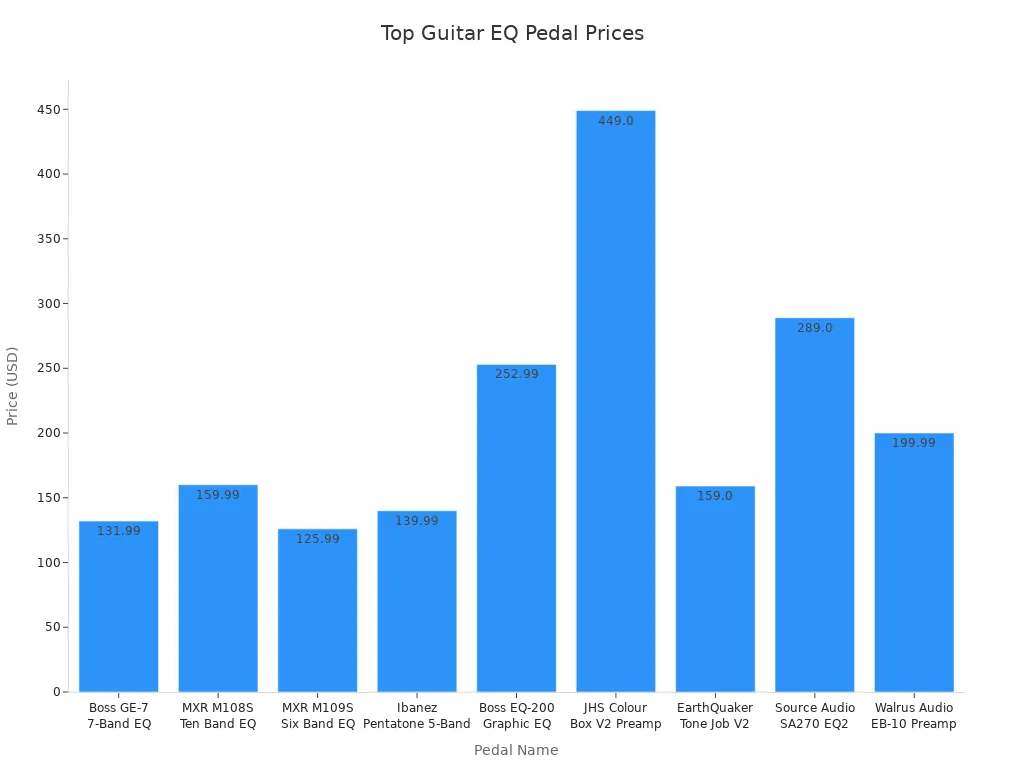
Boss GE-7 | $131.99 | Legendary reliability, clean equalization |
MXR Ten Band EQ
If you want more control, the MXR Ten Band EQ gives you ten bands to play with. This pedal covers a wide frequency range from 31.25Hz to 16kHz. You can shape your sound in detail and even use the Volume and Gain sliders to boost your whole signal. The MXR Ten Band EQ also has two outputs, so you can split your signal chain if you want.
Wide frequency range for deep tone shaping
Volume and Gain sliders for extra boost
Two outputs for creative setups
This pedal is a favorite among players who want precise control. It works well for both live and studio use. The noise-reduction circuitry keeps your sound clean, even when you push the boost.
Nome do pedal | Preço | Caraterísticas principais |
|---|---|---|
MXR M108S Ten Band EQ | $159.99 | Noise-reduction, true bypass, lightweight housing |
Source Audio EQ2
The Source Audio EQ2 stands out as one of the most powerful and flexible best eq pedals you can find. It combines graphic and parametric equalization, giving you ten fully adjustable bands. You can boost or cut each band by up to 18 dB. The EQ2 also has stereo ins and outs, MIDI support, and a hidden tuner.
10 adjustable frequency bands
MIDI accessible presets
Stereo ins & outs
Neuro Desktop Editor and Mobile App for deep editing
You can run two unique EQ settings at the same time. The pedal works for guitar and other instruments. Many pros call it the most advanced equalizer pedal on the market.
Nome do pedal | Preço | Caraterísticas principais |
|---|---|---|
Source Audio SA270 EQ2 | $289.00 | 10 bands, MIDI, presets, stereo, advanced editing tools |
Empress ParaEQ
If you want a pedal that gives you both power and clarity, the Empress ParaEQ is a top choice. This analog pedal offers a clean signal path and true bypass. You get three bands of parametric EQ, up to 30 dB of boost, and 27 volts of headroom. That means you can shape your tone without worrying about clipping or noise.
Advantage | Descrição |
|---|---|
Analog signal path | High-quality sound with minimal interference |
True bypass feature | Clean signal when not in use |
Extensive EQ capabilities | Precise control over frequency bands |
27 volts of headroom | Prevents clipping, keeps clarity |
Up to 30db of boost | Great for solos and cutting through the mix |
Durable construction | Built to last |
Funcionamento silencioso | Minimal noise, even at high outputs |
Intuitive design | Easy and precise adjustments |
Two-in-one pedal | Separate foot switches for EQ and boost |
Flexible EQ adjustments | Selectable bandwidth (Q) for tailored response |
You can use the Empress ParaEQ for both subtle tweaks and big changes. It works well for advanced players who want to fine-tune every part of their sound.
JHS Haunting Mids
The JHS Haunting Mids pedal focuses on the midrange. You can boost or cut mids by up to 15 dB. This pedal lets you dial in the exact mid frequencies you want. It works great with overdrive, distortion, or fuzz pedals. You can make your sound thicker or thinner, depending on what you need.
Parametric mid EQ with 15 dB boost or cut
Frequency control for precise midrange shaping
Works well as a sound enhancer or tone shaper
Caraterística | Descrição |
|---|---|
Tipo | Parametric mid EQ with 15 dB boost or cut |
Frequency Control | Raise or lower specific midrange frequencies |
Aplicação | Enhances distortion or creates a thin, sizzling sound |
Benefício | Effective sound enhancer and tone shaping tool |
If you want to stand out in the mix or add character to your solos, the Haunting Mids gives you the tools to do it.
Tip: Many of the best eq pedals today offer both analog and digital options. Analog pedals give you a warm, natural sound and a tactile feel. Digital pedals offer more features and flexibility. Pick the one that matches your style and needs.
You have a lot of choices when it comes to the best eq pedals. Each one brings something special to your board. Try them out and see which equalizer helps you find your perfect tone.
EQ Pedals Comparison Table
Specs and Features
You want to see how the top eq pedals stack up side by side. Here’s a table that compares the key specs and features you care about. This makes it easier for you to pick the right equalizer for your setup.
Nome do pedal | Bands | Caraterísticas principais | Qualidade de construção | Power Options |
|---|---|---|---|---|
Musontek Remeowdel | 3 | Analog circuitry, +15 dB boost, true/JFET bypass | Compact, sturdy | 9-18V adapter |
Boss GE-7 | 7 | Versatile control, feedback reduction | Durable metal | Battery/adapter |
MXR M108S Ten Band EQ | 10 | Noise reduction, bright LEDs, dual outputs | Lightweight, tough | Adapter |
JOYO EQ Pedal | 10 | Wide frequency range, volume control | Metal | Adapter |
Donner EQ Pedal | 10 | True bypass, compact size | Aluminum alloy | Adapter |
Behringer EQ700 | 7 | LED indicator, wide range | Plastic | Battery/adapter |
MXR Six Band EQ | 6 | Noise reduction, high visibility LEDs | Sturdy | Adapter |
Tip: If you play live, you might want a pedal with bright LEDs and a tough build. If you record at home, you may prefer more bands for detailed eq shaping.
Pros and Cons
Let’s break down what you get with each of these eq pedals. You want to know which ones fit your needs and which ones might be tricky.
Musontek Remeowdel: You get smooth control and a natural tone. The analog design keeps your sound clear. The compact size fits any pedalboard.
Boss GE-7: This pedal is famous for durability. You can cut feedback and shape your sound fast. Some users say the sliders can get noisy.
MXR M108S Ten Band EQ: You get deep control with ten bands. The noise reduction keeps your signal clean. Beginners may find it complex.
JOYO EQ Pedal: You get a wide frequency range and a good price. Some players notice extra noise.
Donner EQ Pedal: This pedal is tough and small. True bypass keeps your signal pure. The sliders may feel less intuitive.
Behringer EQ700: You get a budget-friendly option. The plastic build feels less sturdy.
MXR Six Band EQ: You get a simple layout and noise reduction. No volume slider means less control over output.
You can see that each eq pedal has strengths. Some work better for live gigs, while others shine in the studio. Pick the one that matches your style and helps you shape your tone.
Choosing the Right EQ Pedal
Match to Playing Style
You want your sound to fit your style. The way you set up your board changes how your eq pedal works. Some players like a simple setup. Others build a complex chain with lots of pedals. Your choice depends on what you play and how you play it.
Here’s a table to help you match your eq pedal to your setup:
Setup Type | Descrição |
|---|---|
Minimalist Setup | Simple three-pedal chain with a buffered tuner and true bypass overdrive for minimal tonal coloration. |
Classic Rock Board | Includes impedance-sensitive pedals at the front and buffered delay to maintain signal integrity. |
Modern Versatility Setup | Uses multiple strategic buffers to maintain signal integrity through a complex chain. |
High-Gain Metal Configuration | Buffered noise gate and eq to clean up the signal and maintain aggressive high-gain tones. |
If you play classic rock, you might want an eq pedal that sits early in your chain. This helps you shape your tone before it hits your amp. Metal players often use eq pedals with a noise gate to keep their sound tight and punchy. If you like a minimalist setup, a compact equalizer pedal with true bypass keeps your signal pure.
Don’t forget about common mistakes. Many guitarists ignore the signal chain. You might buy an eq pedal that sounds great alone, but it changes when you add other pedals. Some players think gear alone creates the perfect tone. You need to experiment and practice to get the sound you want.
Tip: Try your eq pedal in different spots on your board. You’ll hear how placement changes your tone. Sometimes, moving the pedal makes a big difference.
Genre and Budget
Your music style matters when you pick an eq pedal. Acoustic players use eq pedals to adjust their sound for strumming or finger-picking. If you play in a band, boosting the mids and volume helps your guitar cut through the mix. More bands on your eq pedal give you extra control. You can fine-tune your sound for any genre.
Here are some expert tips for matching your eq pedal to your genre:
Acoustic players use eq pedals to shape their sound for different techniques.
Boosting mids and volume helps your picking stand out.
More bands mean more control over your tone.
Brands like MXR and Boss offer reliable options with special mods for better performance.
Budget also plays a big role. You don’t need the most expensive pedal to get a great sound. Look for an eq pedal that fits your needs and your wallet. Some pedals offer lots of features for a low price. Others focus on quality and durability. Decide what matters most to you.
Note: Always test your eq pedal with your own gear. Your amp, pickups, and other pedals change how the equalizer works. What sounds good for one player might not work for you.
If you want a simple pedal for home practice, pick one with fewer bands and easy controls. For live shows or recording, choose an eq pedal with more bands and sturdy build. Your style, genre, and budget guide your choice. The right pedal helps you shape your tone and play your best.
You have lots of choices when picking an equalizer for your guitar. Musontek Remeowdel stands out if you want clear tone and easy control. Boss, MXR, and Source Audio pedals also help you shape your sound. Think about your style and budget before you buy. Try a few eq pedals at your local shop or watch demo videos online. You can find the right pedal to match your music.
FAQ
What does an EQ pedal do for my guitar sound?
Um Pedal de equalização lets you boost or cut certain frequencies. You can make your guitar sound brighter, warmer, or punchier. You control your tone and fix problems fast.
Where should I place my EQ pedal in my signal chain?
Most players put the EQ pedal after distortion or overdrive. You can also try it before those pedals. Test both spots and see which one sounds best for you.
Can I use an EQ pedal with acoustic guitar?
Yes, you can use an EQ pedal with acoustic guitar. It helps you shape your sound, reduce feedback, and match your tone to different rooms or setups.
Do I need a graphic or parametric EQ pedal?
If you want quick changes, pick a graphic EQ pedal. If you want deep control, choose a parametric EQ pedal. Both types help you shape your sound.