Un equalizer guitar effect pedal helps players change their guitar sound. It does this by allowing them to adjust certain frequencies. The Musontek Remeowdel is a versatile 3-band EQ pedal that lets musicians modify bass, mids, and treble. This capability helps them achieve the sound they desire. Many guitarists utilize an Equalizer Guitar Effect for various reasons, and both beginners and experts find it beneficial.
You can block radio sounds and other effects, giving your guitar a unique tone.
You can enhance your sound clarity by eliminating harsh frequencies.
You can experiment with new sounds that differ from what an amplifier provides.
You can discover your own style by trying out different settings.
You can boost important frequencies when performing live.
Learning about equalizer guitar effect pedals like the Musontek Remeowdel encourages players to be more creative and enhances their overall guitar sound.
Principaux enseignements
An EQ pedal lets you change bass, mids, and treble. This helps you shape how your guitar sounds.
You can use an EQ pedal to lower sounds you do not want. This makes your music clearer and cuts down on noise when you play.
Try different settings to find a sound that is special to you. This can make your guitar tone better.
Put the EQ pedal early in your signal chain. This gives you more control over your sound before other effects.
The Musontek Remeowdel is easy to use. It is a good choice for new and skilled players.
Equalizer Guitar Effect Basics

An eq pedal lets guitarists change their sound. It helps players adjust bass, mids, and treble. These changes are more exact than most amplifiers. With an eq pedal, you can boost or lower certain frequencies. This shapes how your guitar sounds. The Musontek Remeowdel is a 3-band analog eq pedal. You can change each band by up to +15 dB. This means you can make big or small changes. The pedal uses analog parts and true bypass switching. Your guitar sound stays clear when the pedal is off.
How EQ Pedals Shape Guitar Tone
EQ pedals help guitarists get the sound they want. They let you change the main frequency ranges. These ranges affect how your guitar sounds. The table below shows what different frequencies do:
Gamme de fréquences | Effect on Guitar Tone |
|---|---|
80-100 Hz | Low fundamental, helps your guitar stand out. |
100-250 Hz | Adds weight and body to rhythm guitar tracks. |
300-800 Hz | Gives power and punch, good for vintage tones. |
800 Hz – 2.5 kHz | Helps your guitar stand out, great for solos. |
2.5 kHz – 8 kHz | Makes your guitar clear, but too much can sound harsh. |
8 kHz – 20 kHz | Adds air and shine, makes your sound crisp. |
Players use an eq pedal to boost their guitar in certain frequencies. This helps the guitar be heard without being too loud. Good eq pedals, like the Musontek Remeowdel, make clear and exact changes. Boosting some frequencies can make your guitar sound better. But boosting too much in high ranges can make it harsh. The Musontek Remeowdel lets you change bass, mids, and treble separately. This helps you find the best sound for your guitar.
The Musontek Remeowdel is a 3-band eq pedal. It lets you boost or cut bass, mid, and treble.
Each band can be changed by up to +15 dB. This lets you shape your sound a lot.
The pedal uses analog parts for a clear sound. True bypass keeps your original tone when the pedal is off.
Analog vs. Digital EQ Pedals
EQ pedals come in two types: analog and digital. Each type has good points. The Musontek Remeowdel uses analog parts. Many guitarists like analog for its natural sound. Analog eq pedals sound warmer and more real. They have simple controls and are easy to use. Digital eq pedals have more features. Some players think they are harder to use.
Fonctionnalité | Analog EQ Pedals | Digital EQ Pedals |
|---|---|---|
Sound Quality | Natural, warmer, and more real sound | Clear, exact sound, can sound fake |
User Experience | Simple design, easy setup, fewer choices | More features, can be confusing |
Consistency | Can change with outside factors | Always the same, but may have delay |
Analog parts, like in the Musontek Remeowdel, keep your tone pure. They keep your guitar’s natural sound and add depth. Many people like the smooth knobs and good parts. These help make your guitar sound strong and lively. Some guitarists pick analog eq pedals for their special frequencies and shaping options. Being hand-made and well-built also makes them popular.
Tip: If you want a pure and rich guitar sound, try an analog eq pedal like the Musontek Remeowdel.
Shaping Your Guitar Tone
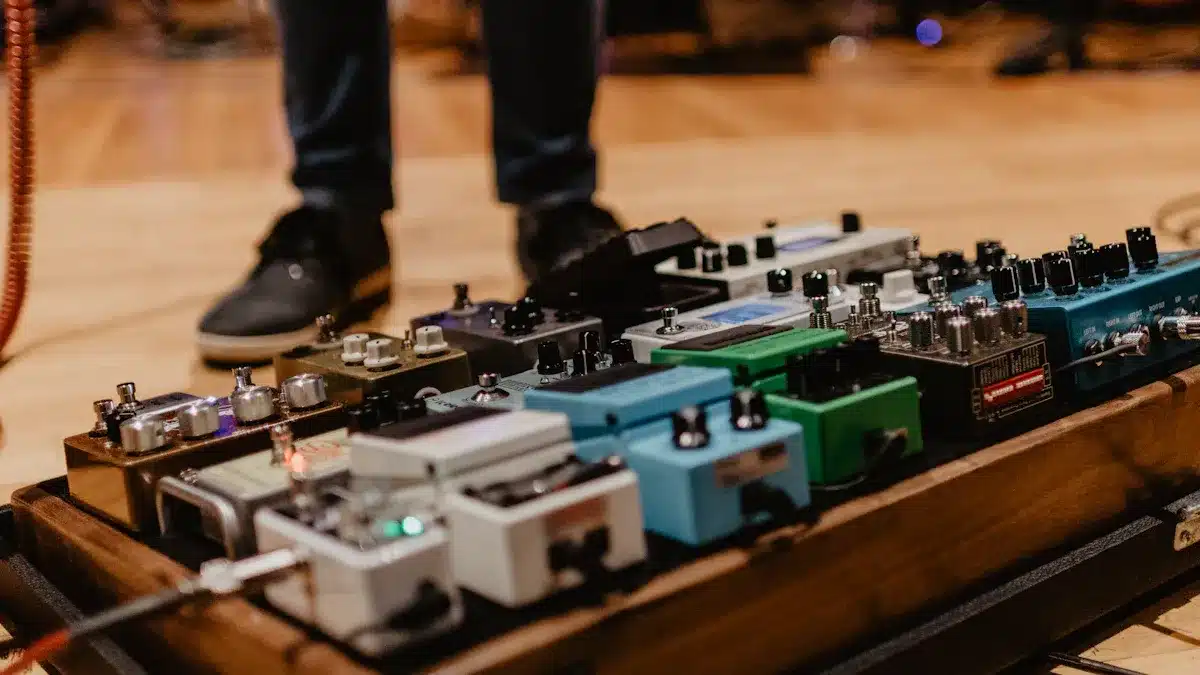
Adjusting Bass, Mids, and Treble
An eq pedal lets guitarists change their sound. You can turn up or down the bass, mids, and treble. This helps you get the right sound for any song. If you boost the bass, your rhythm parts sound deeper and stronger. If you lower the bass, your guitar fits better with other band members. Changing the mids changes how your guitar stands out. If you boost the mids, solos are easier to hear. If you cut the mids, you get a scooped sound. This is good for some rock and metal music. Treble makes your guitar sound bright and clear. If you boost treble, you hear more pick attack and detail. If you cut treble, your sound is softer and less harsh.
The Musontek Remeowdel equalizer pedal lets you boost or cut each band a lot. You can change each band by up to +15 dB. This means you can make small or big changes. This helps you find the best sound for any song or style.
Tip: Try turning up the mids for solos. Lower the bass if the bass player is loud. This helps your guitar sound clear.
Cutting Noise and Feedback
Noise and feedback can mess up your show. An eq pedal helps you fix these problems. It does this by cutting out bad sounds. Guitarists use different tricks to keep their sound clean:
High-pass filter: Cuts out low sounds that cause rumble or feedback.
Notch filter: Cuts out certain sounds that make feedback.
Subtractive equalization: Cuts problem sounds instead of boosting, which lowers noise.
The Musontek Remeowdel has true bypass. When it is off, your guitar sound stays the same. This keeps your sound pure and stops extra noise. You can trust the Remeowdel to keep your guitar tone clean when you play or practice.
Enhancing Harmonics and Clarity
A good eq pedal does more than fix problems. It can make your guitar sound clearer and richer. Boosting some sounds helps your guitar stand out. For solos, boosting between 800Hz and 2.5kHz makes notes louder and clearer. Boosting from 2.5kHz to 8kHz makes your guitar brighter. But do not boost too much here or it will sound harsh.
The table below shows how different eq settings change your sound:
Gamme de fréquences | Action | Effet |
|---|---|---|
150Hz | High Pass | Makes space for the bass |
250-500Hz | Boost/Cut | Adds warmth or makes it clearer |
2kHz | Boost | Makes your sound open and clear |
4kHz | Cut | Cuts out hiss |
5-8kHz | Low Pass | Lowers brightness |
You can boost 250-500Hz for a warm sound. Cutting here makes your sound less muddy. Boosting around 2kHz helps your guitar stand out. Cutting at 4kHz gets rid of hiss. A low pass at 5-8kHz keeps your guitar from being too sharp.
The Musontek Remeowdel uses a JFET boost to make harmonics stronger. This gives you a clear and rich sound with analog equalization. The pedal brings out more harmonics and clearer notes. This makes your guitar sound lively and full.
Note: Try boosting and cutting different sounds to find new tones. The Remeowdel makes it easy to try new settings and hear changes fast.
Using an EQ Pedal Effectively
Signal Chain Placement Tips
Putting an eq pedal in the right place helps your guitar sound better. Most guitarists put the eq pedal near the start of their setup. This lets them change the sound before it goes to other pedals. Some players put the eq after pedals that change volume. This helps fix the sound after boosting or compressing. If your overdrive pedal cannot change enough, try putting the eq after it. This helps you boost or cut certain sounds. You can also put the eq in the effects loop of your amp. This lets you change the whole preamp sound. You get more control before the sound goes to the power amp.
Put the eq pedal early to change your main sound.
Try it after overdrive for more ways to shape your tone.
Use the effects loop to change the sound after gain pedals.
Tip: Try different spots for your eq pedal. The best place depends on your setup. Finding the right spot makes the equalizer guitar effect very useful.
Basic Settings for Live and Studio
Live shows and studio work need different eq pedal settings. At live shows, guitarists often lower sounds below 100 Hz. This stops the guitar from sounding too boomy. Cutting between 300 and 500 Hz helps stop muddiness. Boosting from 1.5 to 2.5 kHz makes your guitar easier to hear. Changing the highs keeps your sound bright but not harsh. In the studio, you may need different settings. The guitar can sound different when recorded. Many players use special settings for live and studio. Changing the eq for each place helps keep your sound clear.
Lower sounds below 100 Hz at live shows.
Cut 300–500 Hz to stop muddiness.
Boost 1.5–2.5 kHz for a clear sound.
Change highs for sparkle but not harshness.
Note: The Musontek Remeowdel makes these changes easy. Its simple controls and big boost range help a lot. This pedal works great for both live and studio playing.
Comparing Graphic and Parametric EQ Pedals
Guitarists can pick a graphic eq pedal or a parametric eq pedal. Each type has different ways to change your sound. The table below shows how they are different:
Fonctionnalité | Graphic EQ Pedal | Parametric EQ Pedal |
|---|---|---|
Contrôle de la fréquence | Fixed bands, not very flexible | You can change the center and width |
Cas d'utilisation | Fast changes, good for cutting bad sounds | More control for creative sound changes |
Complexité | Simple and easy to use | More complex, bands can overlap |
Application | Used a lot in live shows | Used more in studios for more options |
Sound Characterization | Less musical, more plain | Adds color and makes sound more musical |
A 3-band eq pedal like the Musontek Remeowdel is a graphic eq pedal. It lets you quickly boost or cut bass, mids, and treble. This is great for live shows when you need fast changes. Parametric eq pedals give you more control but are harder to use. The Remeowdel is easy to use and can boost a lot. It is a good choice for guitarists who want simple and strong equalization.
Beginners can use guides like The Beginner’s Guide to EQ. These guides show how to use an eq pedal and why it helps shape your guitar sound.
Musicians can control their sound better with an equalizer guitar effect pedal. They change certain frequencies to make their guitar clearer. This also helps stop the guitar from sounding muddy. The guitar stands out more when playing with a band. The Musontek Remeowdel helps players be creative. It lets them change their tone for live shows and studio recordings.
Trying out EQ pedals helps every guitarist find new sounds.
FAQ
How does an EQ pedal affect a guitar’s sound?
An EQ pedal lets players change the balance of frequencies in their guitar signal. They can boost or cut certain frequencies. This helps the guitar fit better with other instruments and the amplifier. Players can make their sound brighter, warmer, or clearer.
Can an EQ pedal reduce feedback during live shows?
Yes. Players use an EQ pedal to cut problem frequencies that cause feedback. By lowering these frequencies, the guitar becomes less likely to feed back through the amplifier. This keeps the sound clean and controlled on stage.
Where should a player place an EQ pedal in the signal chain?
Most players put the EQ pedal before the amplifier. Some place it after distortion pedals. This lets them shape frequencies before the amplifier processes the sound. Placement changes how the frequencies interact with other effects and the amplifier.
What is the difference between a 3-band EQ and a graphic EQ?
A 3-band EQ lets players adjust bass, mid, and treble frequencies. A graphic EQ has more sliders for different frequencies. The 3-band EQ is simple and quick to use. A graphic EQ gives more control over many frequencies.
Does an EQ pedal work with all amplifiers?
Yes. An EQ pedal works with any amplifier. It shapes the frequencies before the amplifier boosts the signal. This means the guitar can sound good with any amplifier, whether it is for practice or performance.