
Understanding Guitar Pedals and Their Role
Guitar pedals are electronic devices that process your guitar’s signal to create various tonal effects and modifications. These compact units sit between your guitar and amplifier, allowing you to shape, enhance, or completely transform your sound with the stomp of a foot. The beauty of guitar pedals lies in their versatility and the creative freedom they provide to musicians across all genres.
The five basic types of guitar pedals we’ll explore represent the core categories that every guitarist should understand: overdrive, fuzz, EQ, compression, and clean boost. Each serves a distinct purpose in your signal chain and offers unique benefits for different playing situations. Understanding these fundamentals will help you build a solid foundation for your pedalboard and develop your signature sound.
| Type de pédale | Fonction principale | Best Used For | Position de la chaîne du signal |
|---|---|---|---|
| Surmultipliée | Smooth saturation and warmth | Blues, rock, country | Early in chain |
| Fuzz | Heavy saturation and sustain | Psychedelic rock, indie | Early in chain |
| QE | Frequency shaping | Tone correction, boosting | Various positions |
| Compression | Dynamic control | Consistent volume, sustain | First in chain |
| Clean Boost | Signal amplification | Volume increase, amp pushing | Various positions |
Overdrive Pedals: The Foundation of Rock Tone

Overdrive pedals are arguably the most essential guitar effects for rock, blues, and country players. These pedals simulate the warm, natural tube amp distortion that occurs when you push a tube amplifier to its saturation point. Unlike harsh digital distortion, overdrive pedals provide smooth, musical clipping that enhances your guitar’s natural tone while adding sustain and harmonic richness.
The key characteristics of overdrive pedals include their touch-sensitive response, meaning they react to your playing dynamics. When you play softly, you get a clean or slightly broken-up tone, but dig in with your pick attack, and the pedal responds with increased saturation. This dynamic response makes overdrive pedals incredibly versatile and musical.
Practical Applications:
- Adding warmth and sustain to clean amp settings
- Pushing an already overdriven amp into higher saturation
- Creating smooth lead tones for solos
- Enhancing rhythm guitar punch and definition
For those seeking exceptional overdrive tone, the Musontek Dream Castle Overdrive represents the pinnacle of overdrive pedal design. Crafted with meticulous attention to detail and extensive testing in professional recording studios, the Dream Castle delivers the warm, tube-like saturation that has defined classic rock tones for decades. Its superior build quality and innovative circuitry ensure reliable performance whether you’re recording in the studio or performing live on stage.
Common Questions About Overdrive Pedals:
Q: Should I use an overdrive pedal with a clean amp or an already overdriven amp?
A: Both approaches work excellently. With a clean amp, the overdrive pedal provides all the saturation. With an overdriven amp, the pedal acts as a boost, adding extra sustain and saturation for lead passages.
Q: What’s the difference between overdrive and distortion?
A: Overdrive typically provides smoother, more natural clipping that preserves your guitar’s fundamental tone, while distortion offers more aggressive, compressed saturation with additional harmonic content.
Fuzz Pedals: Vintage Saturation and Sustain

Fuzz pedals were among the first guitar effects ever created, dating back to the early 1960s. These pedals produce a thick, saturated, and heavily compressed tone that’s instantly recognizable in classic rock, psychedelic, and indie music. Unlike overdrive pedals that aim for natural tube saturation, fuzz pedals create deliberate signal clipping that results in a square wave output, producing that characteristic “buzzy” tone.
The unique character of fuzz comes from its extreme compression and sustain capabilities. Notes seem to bloom and sustain indefinitely, making single-note passages incredibly expressive. The heavy saturation also creates unique harmonic interactions, especially when playing chords, resulting in a wall of sound that can range from smooth and singing to aggressive and chaotic.
Musical Applications:
- Psychedelic rock lead tones with infinite sustain
- Garage rock rhythm parts with aggressive bite
- Indie and alternative music texture creation
- Experimental soundscapes and ambient passages
Les Musontek FURFUR Fuzz exemplifies the perfect balance between vintage character and modern reliability. Drawing inspiration from classic fuzz circuits while incorporating contemporary engineering excellence, the FURFUR delivers that sought-after vintage fuzz tone with exceptional build quality. Each pedal undergoes rigorous testing to ensure it meets Musontek’s exacting standards for professional use.
| Fuzz Characteristic | Tonal Impact | Best Musical Context |
|---|---|---|
| Heavy Compression | Even sustain, reduced dynamics | Lead lines, sustained chords |
| Square Wave Clipping | Buzzy, aggressive texture | Garage rock, punk |
| Contenu harmonique | Rich overtones, chord interactions | Psychedelic rock, experimental |
| Gate/Cleanup | Touch sensitivity when rolled back | Dynamic playing, clean-to-fuzz transitions |
Fuzz Pedal Tips:
Fuzz pedals work best when placed first in your signal chain, directly after your guitar. They’re sensitive to the impedance from your guitar’s pickups and perform optimally with a strong, unprocessed signal. Many players find that rolling back their guitar’s volume control can clean up a fuzz pedal, providing a range of tones from clean to fully saturated within a single pedal.
EQ Pedals: Sculpting Your Perfect Sound
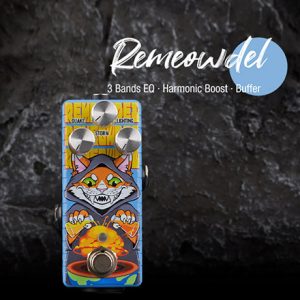
Equalization (EQ) pedals are among the most practical and versatile tools in any guitarist’s arsenal. These pedals allow you to boost or cut specific frequency ranges, enabling precise tone shaping and problem-solving in various musical contexts. Whether you need to cut through a dense mix, warm up a harsh amplifier, or compensate for room acoustics, an EQ pedal provides the surgical precision required for professional sound quality.
EQ pedals come in various configurations, from simple 3-band units to sophisticated graphic EQs with multiple frequency bands. The key to effective EQ use lies in understanding which frequencies affect which aspects of your tone. Low frequencies (80-250 Hz) control thickness and warmth, midrange frequencies (250 Hz-4 kHz) affect presence and cut, while high frequencies (4-20 kHz) determine brightness and clarity.
Practical EQ Applications:
- Correcting problematic room acoustics during live performance
- Matching different guitars’ tones within a single set
- Creating dramatic tone changes between song sections
- Compensating for different amplifiers’ inherent frequency responses
- Enhancing specific frequencies for solos or rhythm parts
Les Musontek Remeowdel EQ represents cutting-edge EQ technology designed specifically for professional musicians. With its intuitive interface and precision frequency control, the Remeowdel allows for both subtle tone tweaking and dramatic sound shaping. Built with high-quality components and subjected to Musontek’s rigorous testing protocols, this EQ pedal delivers transparent operation and reliable performance in any musical situation.
Common EQ Problem-Solving Scenarios:
Problem: Guitar sounds muddy in the mix
Solution: Cut low-mid frequencies (200-500 Hz) while slightly boosting upper midrange (1-3 kHz) for clarity and definition.
Problem: Guitar tone is too harsh or bright
Solution: Gently roll off high frequencies (above 5 kHz) while adding slight low-mid warmth (300-600 Hz).
Problem: Can’t hear guitar in dense band arrangements
Solution: Boost presence frequencies (2-4 kHz) and consider cutting conflicting bass frequencies to create space.
Compression Pedals: Consistency and Control

- Even volume levels across different playing techniques
- Enhanced sustain for single-note passages
- Improved note clarity in complex chord progressions
- Better control over fingerpicked passages
- Smoother transitions between rhythm and lead playing
Les Musontek Super Zip Factory delivers professional-grade compression with musical transparency and intuitive controls. Designed through extensive collaboration with recording artists and live performers, the Super Compressor provides everything from subtle dynamic control to obvious squash effects. Its superior circuitry ensures minimal noise and maximum musical enhancement, meeting the demanding standards expected from Musontek products.
| Compression Setting | Musical Application | Recommended Ratio | Key Benefits |
|---|---|---|---|
| Light Compression | Fingerpicking, jazz | 2:1 to 3:1 | Natural feel with subtle control |
| Medium Compression | Rock rhythm, country | 4:1 to 6:1 | Balanced dynamics and sustain |
| Heavy Compression | Funk, chicken picking | 8:1 to 10:1 | Extreme sustain and attack enhancement |
Compression Best Practices:
Compression pedals work best when placed early in your signal chain, typically first or second after your guitar. This placement ensures that the compressor receives the full dynamic range of your playing before other effects process the signal. Start with subtle settings and gradually increase compression until you achieve the desired sustain and consistency without sacrificing natural dynamics.
Clean Boost Pedals: Pure Signal Enhancement
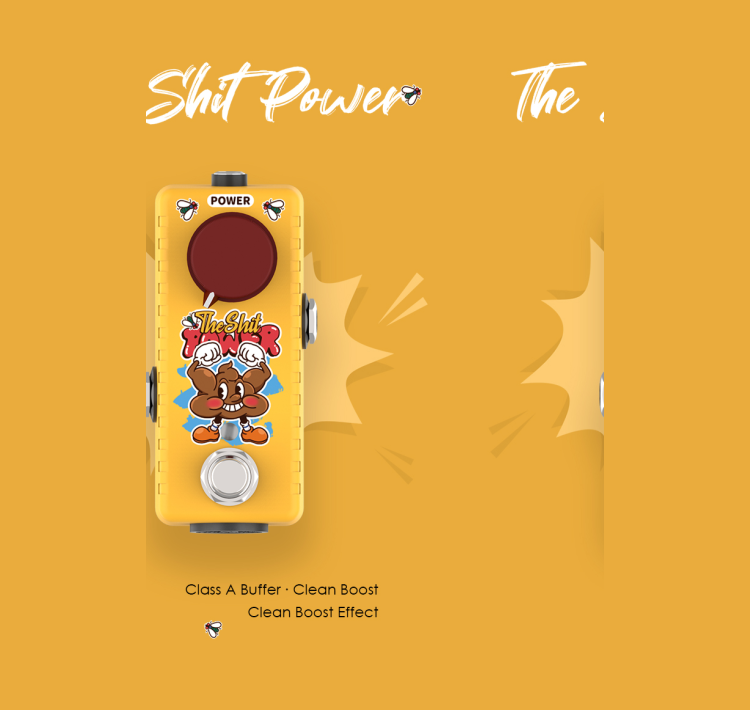
Clean boost pedals represent the purest form of signal enhancement, designed to increase your guitar’s volume without adding coloration or distortion. These seemingly simple devices serve multiple crucial functions: driving your amplifier into natural tube saturation, compensating for signal loss in long cable runs, and providing volume increases for solos or specific song sections. The best clean boost pedals are transparent, meaning they amplify your signal while preserving your guitar and amplifier’s natural tone characteristics.
The effectiveness of a clean boost pedal lies in its simplicity and transparency. Unlike overdrive or distortion pedals that intentionally color your tone, clean boost pedals should be virtually undetectable except for the increased volume and improved signal strength. This makes them invaluable tools for players who love their base tone but need additional volume or want to push their tube amplifiers into sweet spot saturation.
Clean Boost Applications:
- Solo volume boosts without tone change
- Pushing tube amplifiers into natural overdrive
- Compensating for weak pickup output
- Overcoming signal loss from long cable runs
- Providing consistent signal strength across different guitars
- Acting as a buffer for other pedals in the chain
Les Musontek Clean Boost exemplifies transparent signal enhancement at its finest. Engineered to provide up to 20dB of clean gain without introducing noise or unwanted coloration, this pedal serves as the perfect foundation for any pedalboard. Its high-quality components and meticulous construction ensure that your guitar’s natural voice remains intact while providing the power and presence needed for professional performance.
Understanding Clean Boost Placement:
Clean boost pedals offer unique flexibility in signal chain placement, and their position dramatically affects their function. Placed early in the chain, a clean boost drives subsequent overdrive and distortion pedals harder, creating more saturation. Positioned late in the chain, it acts as a master volume control, increasing the overall output without affecting the character of previous effects.
Q: How much boost do I really need?
A: Most applications require only 6-12dB of boost. This amount provides noticeable volume increase for solos while remaining musical. Excessive boost can overload subsequent pedals or amplifier inputs, creating unwanted distortion.
Q: Can a clean boost pedal improve my tone even at the same volume?
A: Yes, even unity gain clean boost can improve tone by providing impedance buffering, which maintains signal integrity and can make your guitar sound fuller and more present.
Optimal Pedal Chain Order and Setup
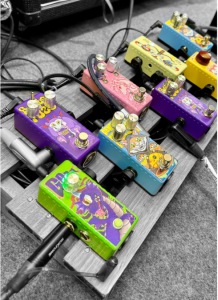
Understanding proper pedal order is crucial for achieving the best possible sound from your effects chain. While personal preference plays a role, certain principles guide optimal pedal placement. The general rule follows the signal path that most naturally mimics how these effects would occur in a recording studio: dynamics first, then drive effects, followed by modulation and time-based effects.
Recommended Signal Chain Order:
- Accordeur – First for accurate tuning reference
- Compression – Controls dynamics before other processing
- Clean Boost – When used to drive other pedals
- Overdrive/Fuzz – Saturation effects work best early
- QE – Can be placed here or later for different functions
- Modulation – Chorus, phaser, flanger effects
- Time-based – Delay and reverb effects last
However, this order isn’t absolute, and experimentation often yields creative results. Some players prefer EQ after drive effects for tone shaping, while others use it before for signal conditioning. The key is understanding how each placement affects your overall sound and adjusting accordingly.
| Type de pédale | Early Chain Benefits | Late Chain Benefits |
|---|---|---|
| Compression | Controls full dynamic range | Evens out final mix levels |
| QE | Shapes input to drive pedals | Final tone sculpting |
| Clean Boost | Drives subsequent effects | Master volume control |
| Surmultipliée | Natural tube-like response | Colors entire effect chain |
Power and Connection Considerations:
Proper power supply and connection methods significantly impact your pedal chain’s performance. Use isolated power supplies to prevent noise and ground loops, and invest in quality patch cables to maintain signal integrity. Musontek pedals are designed to work seamlessly with standard 9V DC power supplies and feature true bypass switching to maintain your signal’s integrity when effects are disengaged.
How to Choose the Right Pedals for Your Style
Selecting the right guitar pedals requires understanding your musical goals, playing style, and the contexts in which you’ll use them. Rather than collecting effects for their own sake, focus on pedals that solve specific tonal problems or enhance your natural playing strengths. Consider your typical playing environments, whether you’re recording in studios, performing live, or primarily playing at home, as each situation has different requirements.
Genre-Specific Considerations:
Blues and Classic Rock: Prioritize overdrive and clean boost pedals for authentic tube-driven tones. A quality compressor enhances sustain for expressive bending and vibrato, while EQ helps cut through band mixes.
Alternative and Indie Rock: Fuzz pedals provide essential texture and attitude, while EQ pedals help achieve the sculpted, recorded sounds characteristic of these genres. Clean boost adds versatility for dynamic arrangements.
Country and Folk: Compression pedals are nearly essential for even fingerpicking dynamics and chicken-picking techniques. Clean boost and subtle overdrive handle the genre’s range from pristine clean tones to slightly driven sounds.
Metal and Hard Rock: While high-gain amplifiers provide most distortion, clean boost pedals tighten response and add definition. EQ pedals help cut problematic frequencies in high-gain settings.
Budget and Quality Considerations:
When building your first pedalboard, prioritize quality over quantity. It’s better to own fewer pedals that you use regularly than many pedals that remain unused. Musontek pedals represent exceptional value, combining professional performance with accessible pricing. Each pedal undergoes extensive testing and quality control, ensuring reliable operation and superior sound quality that rivals much more expensive alternatives.
Professional Recommendation:
Start with one pedal from each category based on your primary musical needs. As you develop your sound and identify specific requirements, gradually expand your collection. Remember that great tone comes from understanding and fully utilizing each tool in your arsenal, not from accumulating the most pedals.
For professional consultation and personalized recommendations, contact Musontek’s expert team at musontek@roxtone.com or visit musontek.com to explore our complete range of professional audio accessories. Our experienced designers and engineers are available to help you achieve your tonal goals with products that meet the highest standards of quality and innovation.
Informations de contact :
Téléphone : +86 574 / +86 574 +86 574 87154705 / +86 574 56138193
Courriel : musontek@roxtone.com
Site web : musontek.com
Located in Ningbo, China, with factory and office facilities equipped for professional product development and testing, Musontek continues to innovate in the professional audio accessories field, guided by our commitment to customer experience, innovative design, and uncompromising quality standards.