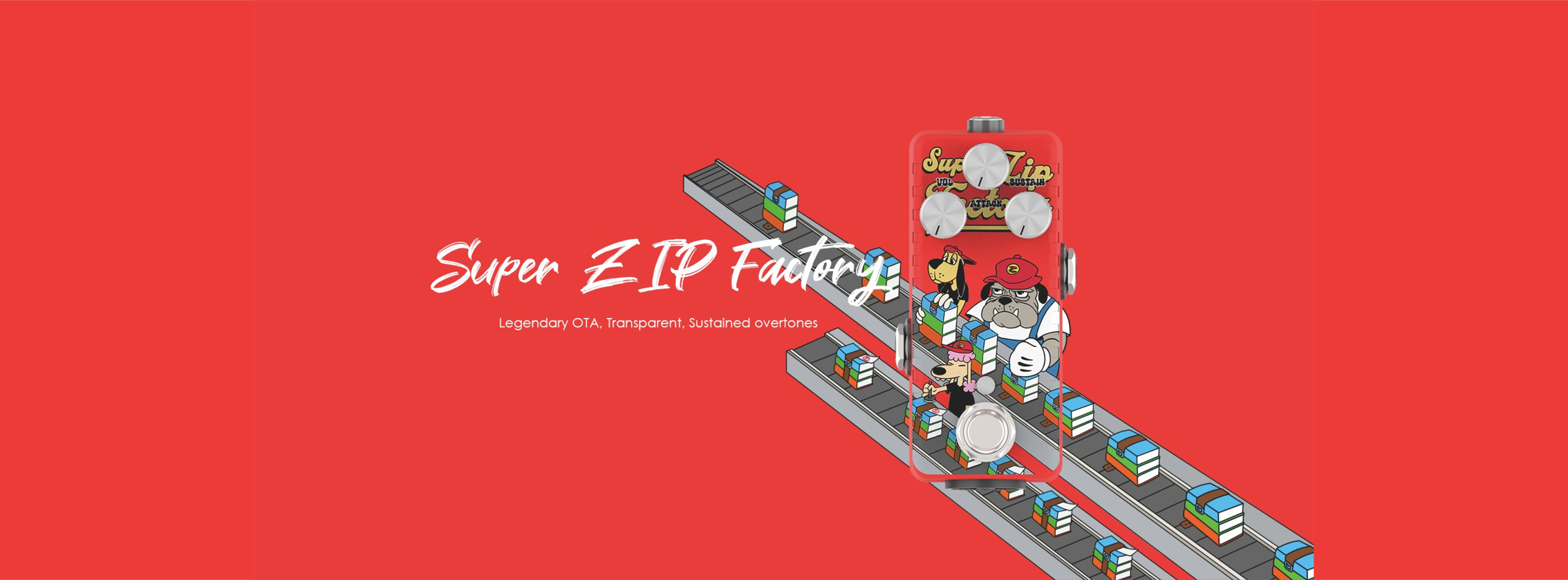
A compressor guitar pedal changes how loud or soft your guitar sounds. An EQ pedal changes the mix of high, middle, and low sounds. The compressor guitar pedal, such as the Dynamics – Super ZlP Factory Compression Pedal from Musontek, makes quiet notes louder and loud notes softer, giving your music a smooth and even sound. EQ pedals, like the Musontek Equalizer Effect: QE – Remeowdel, help you change your tone by raising or lowering bass, mids, and treble. Knowing how these pedals work helps you pick the best sound for any music style.
Principaux enseignements
-
A compressor pedal makes your guitar’s volume even. It turns quiet notes up. It turns loud notes down. This gives you a smooth sound.
-
An EQ pedal lets you change bass, mids, and treble. You can shape your guitar’s tone. This helps you play different music styles.
-
Using both pedals together makes your sound better. The compressor controls how loud or soft notes are. The EQ changes the tone. This gives you a pro sound.
-
Pick your pedals for your music style. Country players like soft compression. Rock players want a strong sound.
-
Try different pedal orders. Putting the compressor before the EQ works well. Testing other setups can help you find your own sound.
Compressor Guitar Pedal Basics
How Compressor Pedals Work
A compressor guitar pedal helps players control how loud their instrument is. It makes quiet notes louder. It also makes loud notes softer. This keeps the sound smooth and even. The Musontek Dynamics – Super ZlP Factory is a favorite for guitar and bass players. It has a special compressor circuit inside. This circuit helps control the dynamic range. Players can change settings like threshold, ratio, attack, release, and output level. These controls help shape the sound for different music styles.
Compressor pedals use different ways to process signals. Some use optical compression. This changes the sound into light for a natural feel. Some use FET compression for a quick attack and a bright sound. VCA compression is steady and clear. OTA compression is common in guitar pedals. Important parts of a compressor pedal are:
-
Release: Decides how long the pedal works and affects how long notes last.
-
Sustain: Makes notes last longer.
-
Blend/Mix: Mixes the changed sound with the original sound.
-
Level/Volume: Changes how loud the pedal is.
-
Soft knee/Hard knee: Changes how the pedal adds compression.
The Musontek Dynamics – Super ZlP Factory gives players many ways to control their sound. It is made of strong metal. It sounds like a studio pedal but does not cost too much.
Sound Impact of Compressor Pedals
A compressor guitar pedal changes how a guitar sounds. It makes quiet sounds louder and helps notes last longer. It also makes loud sounds softer. This keeps the volume even. Many pro guitarists say a compressor pedal is needed for a clear sound. They use it on stage and in the studio. It helps them control the volume but still play with feeling.
The Musontek Dynamics – Super ZlP Factory gives clear sound and long sustain. It does not change the guitar’s tone. The original sound stays the same. Players hear their notes last longer and sound smoother. The pedal helps keep the volume steady when playing.
Here is a table that compares the Musontek Dynamics – Super ZlP Factory to other compressor pedals:
|
Feature/Aspect |
Musontek Dynamics – Super ZlP Factory |
Other Popular Compressor Pedals |
|---|---|---|
|
Sound Quality |
Very clear, studio sound |
Changes tone in some pedals |
|
Options de contrôle |
Many settings to change |
Some have fewer choices |
|
Qualité de construction |
Strong metal case |
Some are not as strong |
|
Prix |
Good price for what you get |
Some cost more for the same |
|
User Reviews |
Good reviews, keeps tone the same |
Mixed, some change the tone |
A compressor guitar pedal helps players get a clear, even, and pro sound.
EQ Pedal Overview
How EQ Pedals Shape Tone
An eq pedal gives guitarists control over their sound. It lets them change the balance of bass, mids, and treble. Players use an eq pedal to boost or cut certain frequencies. This helps them fit their guitar into any mix. The eq pedal works by using filters. These filters can let some frequencies pass and block others. For example, a low-pass filter lets low sounds through and blocks high ones. A high-pass filter does the opposite. By turning the knobs on an eq pedal, players can make their guitar sound brighter, warmer, or more focused.
The inside of an eq pedal uses special parts to shape the sound. The table below shows the main parts found in most eq pedals:
|
Composant |
Description |
|---|---|
|
Input Buffer |
A MOSFET input buffer that increases input impedance and prevents high frequency loss. |
|
Cut/Boost Amplifier |
The core of the eq circuit, configured as a unity gain noninverting amplifier. |
|
Gyrators |
Virtual inductors created with capacitors and op-amps, used to form band-stop filters. |
|
Buffered Half-Rail |
Provides a DC bias and acts as a virtual ground for the gyrators, improving circuit performance. |
These parts help the eq pedal change the guitar’s tone without adding noise. Players can use the eq pedal to fix problems in their sound or to create new tones.
EQ Pedal Sound Effects
An eq pedal changes the way a guitar sounds by adjusting different frequency bands. Each band affects the tone in a special way. The table below shows how changing certain frequencies can shape the sound:
|
Gamme de fréquences |
Effect on Tone |
|---|---|
|
80-100 Hz |
Low fundamental frequency for clarity. Too much can cause muddiness. |
|
80-200 Hz |
Cuts muddiness and tightens low end. |
|
800Hz-1.6kHz |
Boosts midrange for solos to cut through mix. |
|
3-5 kHz |
Reduces harshness in treble. |
|
Upper mids and treble |
Enhances solos without a blanket volume boost. |
Players use the eq pedal to make their guitar stand out or blend in. For example, boosting the midrange helps solos cut through a band. Cutting the low end removes muddiness. Reducing the treble can make the sound less harsh. The eq pedal gives players the power to shape their sound for any song or style.
Tip: Try small changes on your eq pedal first. Even a little boost or cut can make a big difference in your tone.
The eq pedal is a key tool for every guitarist. It helps them find their unique sound and solve problems in any playing situation.
Compressor Pedal vs EQ: Key Differences
Function and Purpose
A compressor pedal and an eq pedal serve different roles in shaping guitar sound. The compressor pedal controls the dynamic range. It makes quiet notes louder and loud notes softer. This helps players keep their volume steady. The eq pedal changes the balance of frequencies. It lets players boost or cut bass, mids, or treble. The eq pedal helps shape the tone to fit different music styles.
Musicians use the compressor pedal to smooth out their playing. They use the eq pedal to adjust the sound for clarity or warmth. The main difference in function is that the compressor pedal manages volume changes, while the eq pedal shapes the tone.
Note: The eq vs compressor debate often comes down to what a player wants to change—volume or tone.
Tone and Dynamics Impact
The compressor pedal affects how the guitar responds to picking and strumming. It keeps the sound even and adds sustain. Players notice that their notes last longer and sound smoother. The compressor pedal does not change the basic tone. It works on the loudness and feel of the music.
The eq pedal changes the character of the sound. It can make a guitar sound bright, dark, thin, or full. Players use the eq pedal to fix problems like muddiness or harshness. The eq pedal can help a guitar stand out in a band or blend in with other instruments.
Here is a table that shows how each pedal affects tone and dynamics:
|
Type de pédale |
Impact on Tone |
Impact on Dynamics |
|---|---|---|
|
Compressor pedal |
Keeps tone natural |
Smooths out volume |
|
Pédale d'égalisation |
Changes tone shape |
Does not affect volume |
Typical Use Cases
Players choose a compressor pedal when they want a smooth and controlled sound. They use it for clean rhythms, solos, and styles that need even volume. The compressor pedal works well for country, pop, and rock music. It helps players sound professional on stage and in the studio.
The eq pedal is useful when players need to change their tone for different songs or settings. They use the eq pedal to boost mids for solos or cut bass for clarity. The eq pedal helps players fix problems in their sound and create new tones. It is a key tool for recording, live shows, and practice.
Here are some common scenarios:
-
A guitarist uses a compressor pedal to keep their picking even during fast strumming.
-
A player uses an eq pedal to make their guitar sound brighter for a solo.
-
In a band, the eq pedal helps the guitar fit into the mix without clashing with other instruments.
-
The compressor pedal helps bass players keep their notes clear and steady.
Tip: Players often use both pedals together. The compressor pedal controls dynamics, and the eq pedal shapes the tone. This combination gives the best sound for many styles.
The eq vs compressor choice depends on what a player wants to improve. The compressor pedal is best for managing volume and sustain. The eq pedal is best for changing the sound and fixing tone issues.
Choosing and Using Compressor and EQ Pedals
Selecting Based on Your Needs
Players pick pedals based on what music they play. Country players like gentle compression for smooth sound. They use moderate threshold and low ratio settings. Rock and metal players want a strong, punchy sound. They use higher ratios and fast attack. Jazz and blues players want their tone to stay natural. They use gentle compression and slow attack. The table below shows how pedal settings change for each genre:
|
Genre |
Threshold |
Ratio |
Attack |
Release |
|---|---|---|---|---|
|
Country |
Modéré |
Low (2:1 or 3:1) |
Moderate to Slow |
Moderate to Fast |
|
Rock/Metal |
Moderate to Low |
Higher (4:1 or more) |
Fast |
Moderate to Fast |
|
Jazz/Blues |
Moderate to Gentle |
Low (2:1 or 3:1) |
Slow |
Modéré |
Players use eq pedals to change their sound. They boost mids for solos or cut bass for a clearer tone. Some guitarists fix problems with eq pedals. Others use eq to make new sounds for different songs. The best pedal depends on what the player wants and the music they play.
Using Both Pedals Together
Where you put pedals in your setup changes the sound. Experts say to put the compressor pedal first. This helps control loud and soft sounds before other effects. The chart below shows the best order for pedals:
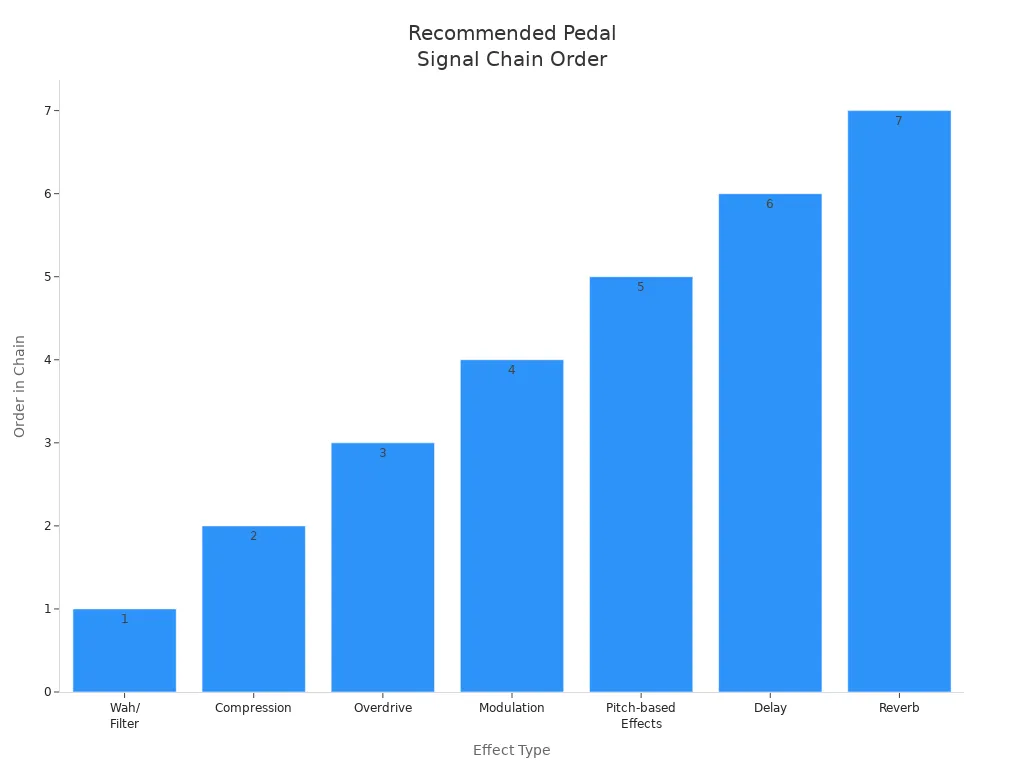
|
Type d'effet |
Order in Chain |
|---|---|
|
Wah/Filter |
1 |
|
Compression |
2 |
|
Surmultipliée |
3 |
|
Modulation |
4 |
|
Pitch-based Effects |
5 |
|
Delay |
6 |
|
Reverb |
7 |
Players can try different pedal orders. Putting eq before compression changes the tone first. This can make the sound special. Using eq after compression makes the sound clearer. Some players fix sound problems with eq before compression. Others use eq after compression for final tweaks. Testing both ways helps players find what works best.
Tip: Using eq and compressor pedals together gives more control. Players can get a balanced, clear, and pro sound.
Compressor pedals help control how loud and long notes are. EQ pedals change the way the guitar sounds. Players should pick pedals that fit their music style. The table below gives expert advice:
|
Genre |
Recommended Pedals |
|---|---|
|
Blues and Classic Rock |
Overdrive, Clean Boost, Compressor, EQ |
|
Alternative and Indie Rock |
Fuzz, EQ, Clean Boost |
|
Country and Folk |
Compression, Clean Boost, Subtle Overdrive |
|
Metal and Hard Rock |
Clean Boost, EQ |
Some mistakes players make are:
-
Using too much compression
-
Putting pedals in the wrong order
-
Not thinking about attack and release
-
Picking pedals that do not match their style
Trying out both pedals helps players find their own sound. It also helps them play well in any place.
FAQ
What does a compressor pedal do for guitar players?
A compressor pedal helps players control the volume of their guitar. It makes quiet notes louder and loud notes softer. This creates a smooth and even sound. Many musicians use it for clean, professional results.
How does an eq pedal change a guitar’s sound?
An eq pedal lets players adjust the bass, mid, and treble frequencies. By turning the eq knobs, they can boost or cut certain sounds. This helps shape the guitar’s tone for different songs or styles.
Should a player use a compressor or an eq pedal first in the signal chain?
Most players put the compressor before the eq pedal. This order helps control the guitar’s dynamics before shaping the tone. Some players experiment with different orders to find their favorite sound.
Can an eq pedal fix a muddy or harsh guitar tone?
Yes, an eq pedal can solve many tone problems. Players cut low frequencies to remove muddiness or reduce high frequencies to soften harsh sounds. The eq pedal gives them control over their tone in any setting.
Do beginners need both a compressor and an eq pedal?
Beginners do not need both pedals right away. Many start with an eq pedal to shape their sound. As they learn, they add a compressor for more control. Both pedals help players improve their tone and playing.