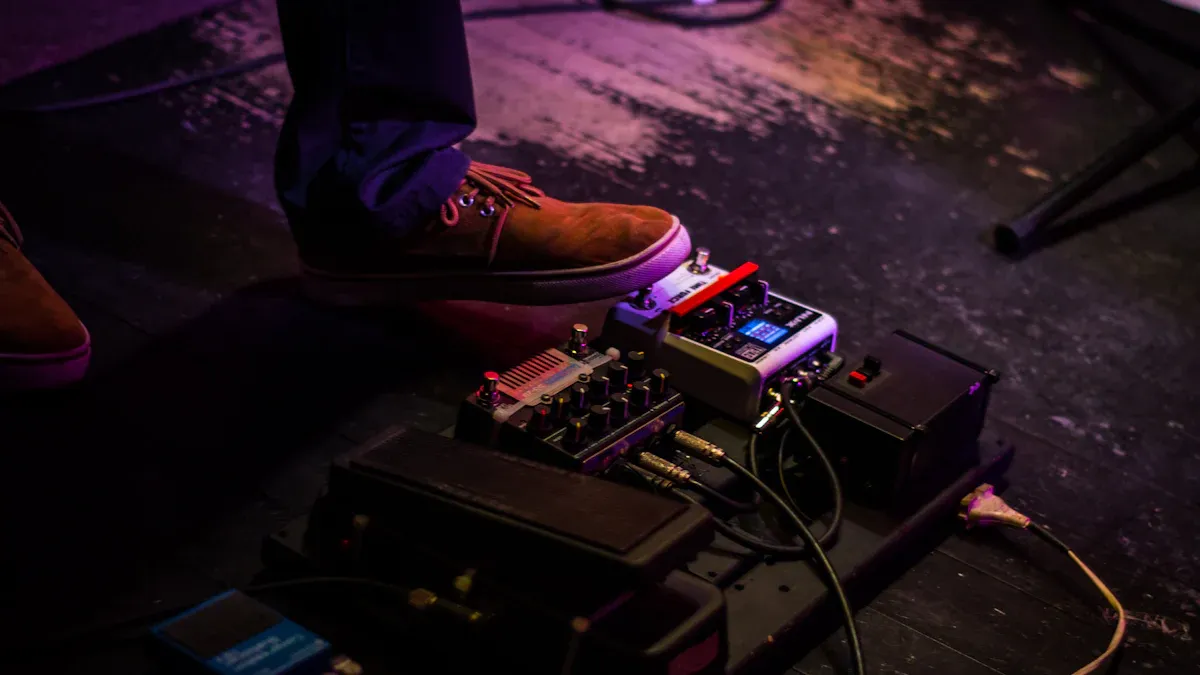
Pedal switchers can be helpful for guitarists, but it depends on what each player wants. Some musicians use just a compression pedal or a boost effect pedal. Others use a delay reverb pedal, fuzz pedal, and distortion overdrive pedal to get more sounds. In the last five years, more players have tried digital tools and new technology. The market for guitar effects and pedal switchers is getting bigger as electric guitars and live music become more popular. Each guitarist should think about how many pedals they have, how hard their board is to use, and how fast they need to change sounds.
Key Takeaways
Pedal switchers make it easier to use many effects pedals. They let musicians change sounds fast and easily when playing live.
They keep the signal path clean. This lowers noise and keeps the sound good. This is important for live shows and recording in studios.
There are different pedal switchers for different needs. Some are simple for beginners. Others are advanced and have programmable or MIDI features for pros.
A pedal switcher can help players be more creative. It lets them try new pedal mixes and ways to connect pedals.
Before buying a pedal switcher, musicians should look at their setup. They should count their pedals and think about what they need for shows. This helps them pick one that fits their style.
What are pedal switchers?
Pedal switchers let guitarists use many effects pedals together. These devices help make big pedalboards easier to use. Players can change their sounds fast during songs. Pedal switchers also help keep the signal neat and clear.
How pedal switchers work
Pedal switchers link to each effects pedal with their own loops. Each loop holds one pedal or a group of pedals. The player uses footswitches to turn loops on or off. This way, the player can pick which pedals are working without stepping on each one. Many pedal switchers let users save groups of loops as presets. With one press, a player can use a preset and turn on many pedals at once.
Tip: Some pedal switchers have built-in buffers. These keep the guitar sound strong and clear, even with long cables or lots of pedals.
Here are some main things pedal switchers can do:
Save any group of loops as one preset.
Turn loops on and off by themselves.
Use built-in buffers and control when they work.
Function/Feature | Description |
|---|---|
Select combinations of pedals | Lets users pick custom pedal groups in one step. |
Change order of pedals | Lets you change pedal order when saving a preset. |
Bypass unused pedals | Keeps the signal path clean by skipping pedals not in use. |
Control amplifier settings | Sends commands to amps for channel or effects switching. |
MIDI patch selection | Lets you pick multi-effect patches using MIDI. |
Display for naming patches | Lets users name and organize patches for easy access. |
Signal buffering | Buffers the signal at the start or end of the chain. |
Individual loop control | Switches loops on and off or saves groups as presets. |
Parallel loop running | Runs loops side by side for more complex sounds. |
Types of pedal switchers
Pedal switchers come in different kinds. Some are simple and only use a few loops. Others have more features like MIDI control and patch naming. Here are some common types:
Basic loop switchers: These have a few loops and simple footswitches.
Programmable switchers: These let users save presets and change pedal order.
MIDI-enabled switchers: These control pedals and amps that use MIDI.
Compact switchers: These fit on small pedalboards and are easy to use.
Each type is good for different players. A player with lots of pedals might want a programmable or MIDI switcher. Someone with a small setup might pick a basic or compact model. Pedal switchers help players keep their effects neat and play better.
Who needs pedal switchers?
Gigging and live performers
Gigging musicians often need to change sounds quickly during a show. They may use many effects pedals to create different tones for each song. Pedal switchers help them move between sounds with one step. This saves time and keeps the music flowing. A performer can focus on playing instead of stepping on many pedals. Fast changes also help when playing in front of an audience. Mistakes become less likely, and the show feels smoother.
Many types of musicians use pedal switchers on stage. These include:
Guitarists
Bassists
Keyboardists
Drummers
Percussionists
Horn players
Vocal artists
Beatboxers
Multi-instrumentalists
Each of these musicians can control their effects more easily with a switcher. This makes live shows more exciting and professional.
Studio and session players
Studio and session players often work on many songs in a short time. They need to switch between sounds fast to match each track. Pedal switchers help them save presets for different songs or artists. This means they can recall the right sound with one press. The studio environment also demands a clean signal. Pedal switchers keep the signal path short and clear. This helps record the best possible sound.
Note: Studio players often use advanced switchers with MIDI control. This lets them control both pedals and digital gear at the same time.
Home and hobbyist musicians
Home players and hobbyists also benefit from pedal switchers. They may not play live, but they still want easy control over their effects. A switcher helps them try new pedal combinations without moving cables. It also keeps their setup neat and simple. Beginners can learn about effects faster by using a switcher. They can focus on playing and having fun.
Pedal switchers fit many types of musicians. They help anyone who wants better control, faster changes, and a cleaner sound.
Benefits of pedal switchers
Pedal switchers give musicians more control over their effects. They help with big pedalboards, make sound better, and let players try new ideas. Musicians can use pedal switchers to make their setup work better on stage or in the studio.
Fast effect changes
Musicians often need to change sounds quickly when playing. Pedal switchers let them turn on many effects at once with one press. This saves time and keeps the music going. The table below shows how pedal switchers help with fast changes:
Feature | Benefit |
|---|---|
Innovative routing flexibility | Lets players change the order of effects fast. |
Parallel effect chains | Gives more sound choices and creative options. |
Programmable switching | Lets players use saved setups right away for smooth shows. |
Professional musicians use pedal switchers to control lots of effects. They can save and use presets for different songs or styles. This makes live shows easier and lets players focus on playing, not stepping on pedals.
Cleaner signal and tone
Long cables and lots of pedals can make a guitar sound weak or noisy. Pedal switchers help keep the signal short and clean. Many have buffers that fix lost high notes and keep the sound clear.
Utility pedals like Buffer/Preamp and Buffer/Splitter fight ‘Tone Suck.’ This happens when long cables and many pedals hurt the signal. These pedals bring back high notes and make the sound better. They are important for a clean signal.
Pedal switchers also help keep the pedalboard neat. This means less tangled wires and less noise. The sound is better both live and in the studio. Players hear a stronger and clearer tone when they use pedal switchers.
Creative routing options
Pedal switchers let musicians try new ways to shape their sound. They allow creative routing, so players can use new pedal chains. Some switchers let you run effects side by side, mix signals, or switch between amps. Here are some creative routing ideas:
Switch between two amps for different sounds.
Mix wet and dry signals for cool effects.
Use one stomp to reach complex pedal chains.
Try two-input/one-output or one-input/two-output setups.
Play one instrument through two amps in stereo.
Put two instruments into one effect chain.
These features help musicians find new sounds and styles. For example, using a pedal switcher with the Musontek MOD – Voyager Delay Pedal lets players add warm delay or make loops during a solo. The MOD – Voyager’s easy controls and wide delay range work well with pedal switchers. Players can use the infinite loop to stack sounds and add depth. Using a pedal switcher and a pedal like the MOD – Voyager gives more control and creativity on stage.
Pedal switchers also help with big setups. They let players control many effects with one button, save and use presets, and keep the pedalboard tidy. This makes shows more reliable and keeps the sound good in different places.
Drawbacks and considerations
Cost and complexity
Musicians see that pedalboards can get expensive fast. A loop switcher usually costs between $100 and $1,000. Most effects pedals cost about $150 each. Some special or old pedals can cost up to $300. If you buy a few pedals and a switcher, the price can go over $1,000.
Buying a loop switcher makes the pedalboard bigger and more costly.
Each new pedal adds more money to the total.
Some players think the cost is not worth it if they use only a few effects.
Many skilled guitarists like to keep things simple. They often plug their guitar right into the amp. This way, they skip the extra cost and trouble of a big pedalboard.
Learning curve
It can take time to learn how to use a pedal switcher. Some models, especially with MIDI, need more tech skills. Players might spend hours reading guides or watching videos. Even simple switchers can be tricky to set up at first.
The price can be too high for people who use few effects.
Setting up a MIDI switcher can be hard for new players.
Players might need to try different settings to get the sound they want.
Some musicians get annoyed by the setup steps. They may want to keep things easy so they do not get confused.
Space and compatibility
A switcher takes up more space on a pedalboard. Some players do not have much room for extra gear. A big switcher might not fit with all their pedals. Sometimes, pedals do not work well with every switcher. This happens if pedals need special power or have different signal needs.
Note: Setting up and taking care of a big pedalboard can be a lot of work. Some musicians find that a simple setup fits their style and sound better.
Players should check their space and what pedals they use before picking a switcher. This helps them avoid problems and keeps their setup easy to use.
Deciding if pedal switchers are right for you
Checklist for your needs
Choosing the right gear can make a big difference in how a musician plays. Before buying a pedal switcher, a player should ask a few important questions. This checklist helps musicians decide if a switcher fits their setup:
How many pedals are on the board?
Does the player need to change sounds quickly during a song?
Are there problems with signal loss or unwanted noise?
Does the player want to keep the pedalboard neat and organized?
Are there effects, like the Musontek MOD – Voyager, that need to be turned on and off together?
Does the player want to try new pedal orders or creative sound paths?
Is the setup used for live shows, studio work, or home practice?
Does the player feel comfortable learning new gear?
Tip: Musicians who use more than three pedals or want to save time during performances often find a switcher very helpful.
A player should also think about performance needs. Some important needs include the ability to turn on several pedals at once, keep the sound clear, and change the order of effects without moving cables. A switcher can help keep the board organized and protect the signal if one pedal fails.
Real-world scenarios
Musicians use pedal switchers in many ways. Here are some real-life examples that show both the benefits and challenges:
A touring guitarist uses a switcher to control eight pedals. He changes from a clean sound to a heavy solo with one step. This makes his show smoother and more exciting.
A studio player records many songs in one day. She saves presets for each song. This lets her switch sounds fast and keeps her recordings clean.
A hobbyist tries a switcher at home. He enjoys testing new pedal chains and sounds. Sometimes, he feels confused by all the options and spends extra time setting up.
A band member uses a switcher to keep his pedalboard neat. He finds it easier to fix problems when something goes wrong.
Pedal switchers help musicians manage complex setups and reduce the need for manual changes. Some players may feel overwhelmed by the many choices, which can make things harder instead of easier.
Alternatives to pedal switchers
Not every musician needs a pedal switcher. Some players use other ways to control their effects:
Alternative | Description |
|---|---|
Manual switching | The player steps on each pedal as needed. Good for small boards. |
Multi-effects units | One device offers many sounds and effects. Easy to use and saves space. |
Pedals with built-in loops | Some pedals, like loopers, let players add or remove effects in one step. |
Minimalist setups | Fewer pedals mean less need for extra gear. |
Note: Players who use only a few pedals or want a simple setup may not need a switcher. Multi-effects units or simple boards can work well for them.
Musicians should think about their own needs, the number of pedals, and the types of effects they use. For example, a player who uses the Musontek MOD – Voyager Delay Pedal and wants to explore creative sounds may find a switcher very useful. Others may prefer to keep things simple and stick with manual control.
Pedal switchers give musicians lots of good things. They let you keep pedals separate, change effects fast, and many are small and work with MIDI. But some models only let you use one path. They can make cable setup harder. Sometimes, they might make your sound weaker.
Pros | Cons |
|---|---|
Keep pedals separate in the loop | Only one path in some models |
Change pedal order quickly | More cables to manage |
Small and work with MIDI | Sound might get weaker |
The best choice depends on what each player needs. Musicians should look at both the good and bad sides before getting a pedal switcher.
FAQ
What does a pedal switcher do?
A pedal switcher lets a musician control many effects pedals with one device. It helps change sounds quickly and keeps the signal clean. Players can use presets to turn on several pedals at once.
Can a pedal switcher improve sound quality?
Yes. A pedal switcher can keep the signal path short and clean. Many models use buffers to prevent signal loss. This helps the guitar or bass sound clear and strong, even with many pedals.
Do beginners need a pedal switcher?
Most beginners do not need a pedal switcher. Players with only a few pedals can switch them by hand. A switcher becomes helpful when the pedalboard grows or when fast changes are needed.
Will any pedal work with a switcher?
Most pedals work with switchers. Some pedals may need special power or have unique input and output needs. Players should check their pedals and the switcher’s manual for compatibility.
How does a pedal switcher help with live shows?
A pedal switcher lets a performer change sounds instantly. This helps keep the music smooth and reduces mistakes. Players can focus on playing, not stepping on many pedals.